

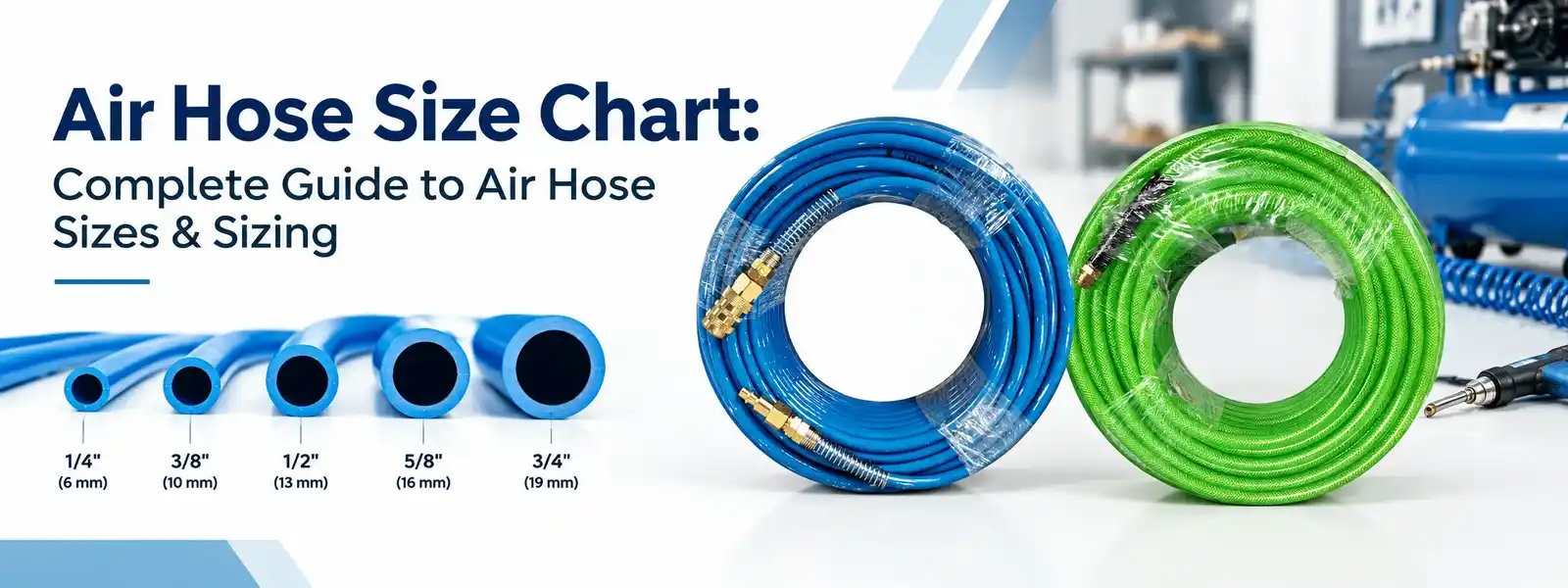
Choosing the right air hose size helps keep pneumatic tools working as expected. A hose that is too narrow can restrict airflow, especially over longer distances. One that is unnecessarily large can add weight and make handling harder. For professionals who use compressed air daily, the goal is to balance airflow, hose length, working pressure and ease of handling. Understanding these factors makes hose selection more straightforward.
Factors That Affect Air Hose Size Determination
Several factors determine which air hose size will work best for your application. Each affects how efficiently compressed air reaches the tool.
- Air consumption: Check how much air your tool requires, usually listed in CFM or SCFM. Tools with higher air demand generally need a hose with a larger internal diameter.
- Hose length: Longer hoses create more resistance to airflow. A 50-foot hose and a 150-foot hose of the same diameter may deliver different amounts of air under the same operating conditions.
- Working pressure: Check the pressure your tool needs at its inlet. The hose must also have a suitable working-pressure rating for the compressed-air system.
- Fittings and couplers: Narrow passages in connectors can restrict airflow, even when the hose diameter is sufficient. Check the flow capacity and compatibility of the complete connection.
Also Read: Air Hose Fittings Types: Complete Guide & Uses
- Operating conditions: Temperature, abrasion, exposure to oils and the need for frequent movement affect the choice of hose material and construction.
Air Hose Size Chart: Sizes, Airflow and Applications
Air hoses come in several standard nominal inside diameters. The table below provides a starting point for selecting a size based on common applications. Actual airflow depends on hose length, pressure, construction and connection restrictions.
| Hose inside diameter | Metric equivalent | Airflow guidance | Common applications |
| 1/4 inch | 6.35 mm | Lower flow capacity | Brad nailers, staplers, blow guns, tire inflators |
| 5/16 inch | 7.94 mm | Between 1/4 and 3/8 inch | Light pneumatic tools and selected workshop applications |
| 3/8 inch | 9.53 mm | Moderate flow capacity | Impact wrenches, air ratchets, framing nailers, grinders |
| 1/2 inch | 12.7 mm | Higher flow capacity | High-demand pneumatic tools, spray systems and some abrasive blasting setups |
| 3/4 inch | 19.05 mm | High flow potential | Industrial air distribution and selected high-demand equipment |
| 1 inch | 25.4 mm | Very high flow potential | Large industrial pneumatic equipment and high-volume air distribution |
Important: Do not treat hose diameter as a fixed CFM rating. The same hose size can deliver different airflow depending on operating pressure, hose length, fittings and acceptable pressure drop.
Also Read: 1/4 Air Hose vs 3/8 Air Hose: Which Size Should You Choose for Air Compressors?
How Air Hose Sizes Are Measured
Air hose dimensions can be confusing when the hose, fitting and connector have different nominal sizes. Start by identifying the hose’s inside diameter, then verify the remaining specifications separately.
Inside Diameter vs. Outside Diameter
The nominal size of a conventional air hose generally refers to its inside diameter (ID). This is the bore through which compressed air flows. The outside diameter (OD) includes the hose wall and any reinforcement, so it is larger.
Before ordering a replacement, check the manufacturer’s specifications or the markings printed on the hose. If the size is unclear, measure the inside opening with suitable measuring equipment. Do not assume that the outside diameter tells you how much air the hose can carry.
What Size Air Hose Do You Need for Your Tool?
The correct size depends on the tool’s air consumption, operating pressure and how far the hose must run. Use the following table as an initial guide, then confirm the tool manufacturer’s requirements.
| Tool or application | Starting point for selection | Key consideration |
| Brad nailers and staplers | 1/4 inch may be sufficient | Intermittent air demand and hose length |
| Framing nailers | Consider 3/8 inch | Firing frequency and pressure at the tool |
| Impact wrenches | 3/8 inch may suit many 1/2-inch drive models | Actual consumption and required inlet pressure |
| Air ratchets | Often 3/8 inch for workshop setups | Tool specifications and frequency of use |
| Die grinders and sanders | Compare 3/8 and 1/2 inch | Continuous airflow demand |
| HVLP spray guns | Evaluate 3/8 and 1/2 inch | Gun-specific air consumption and pressure |
| Sandblasting equipment | Larger diameters may be needed | High, sustained airflow demand |
| Large industrial impact tools | Size according to the tool and system | High airflow requirements and connection restrictions |
Also Read: What Size Nails for Framing? Framing Nail Sizes Complete Guide
How to Choose the Right Air Hose Size
Once you know the tool’s requirements, compare them with the hose’s capacity under your working conditions. These four checks help you narrow down the right size.
Check Your Tool’s Air Consumption
Air consumption tells you how much compressed air a tool needs. It is commonly expressed in CFM or SCFM. Check the tool manual or technical specification sheet before choosing a hose.
- CFM: Cubic feet per minute. It describes volumetric airflow.
- SCFM: Standard cubic feet per minute. It expresses airflow at defined standard reference conditions.
- Intermittent consumption: Tools such as nailers draw air in short bursts.
- Continuous consumption: Tools such as grinders may require a steady air supply while operating.
Do not confuse average consumption with peak demand. A hose that works for intermittent use may restrict a tool that runs continuously.
Consider Hose Length
The distance between the compressor or air outlet and the tool affects the amount of resistance the air encounters. Longer runs generally produce greater pressure loss.
Choose enough length to reach the work area without stretching the hose. Avoid adding unnecessary length, particularly when using smaller diameters or high-demand tools. If a long run is unavoidable, check whether a larger bore can maintain the required airflow.
Check the Required Operating Pressure
PSI measures pressure, not airflow. A tool may require 90 PSI at its inlet, but the pressure available at the tool can be lower when air is flowing through a restrictive hose and its connections.
Check both the tool’s required inlet pressure and the hose’s maximum working-pressure rating. The hose must be suitable for the pressure supplied by the system under its intended operating conditions.
Account for Fittings and Couplers
The hose is only one part of the air delivery system. A restrictive coupler, undersized fitting or unsuitable connector can reduce airflow even when the hose diameter is adequate.
Check the connection thread, fitting bore, coupler profile and rated working pressure. Make sure the entire assembly supports the tool’s requirements rather than choosing a hose based on diameter alone.
1/4-Inch vs. 3/8-Inch vs. 1/2-Inch Air Hose
These three sizes cover many common applications, but they serve different needs. Compare them based on the actual tool requirements rather than choosing the largest available diameter.
| Comparison factor | 1/4 inch | 3/8 inch | 1/2 inch |
| Typical use | Light-duty tools | General workshop use | Higher-flow applications |
| Airflow potential | Lower | Moderate | Higher |
| Handling | Usually light and easy to manage | Balanced | Often heavier and stiffer |
| Longer hose runs | More sensitive to pressure drop | Depends on flow and length | Better suited to many high-flow runs |
| Relative cost | Often lower | Often moderate | Often higher |
How to Choose the Right Air Hose Material
Hose material affects flexibility, handling, durability and suitability for different working conditions. Once the diameter and pressure requirements are clear, select a material that suits the environment.
| Material | Main characteristics | Potential applications |
| Rubber | Often flexible and durable; heavier than many alternatives | Workshops and demanding work environments |
| Polyurethane | Lightweight and easy to handle | Portable tools and mobile jobsites |
| PVC | Often economical; flexibility can vary with temperature | Suitable general-purpose applications |
| Hybrid polymer | Can balance weight and flexibility | Workshop and jobsite use |
Also Read: Flexible Air Hose: Types, Uses, Applications & Selection Guide
Polyurethane vs PVC Air Hose: Which One Is Better for Contractors, Air Compressors & Industrial Use?
Common Air Hose Sizing Mistakes
1. Choosing the Wrong Diameter
An undersized hose can restrict airflow and reduce tool performance. Check your tool’s air consumption and hose length before selecting the diameter.
2. Ignoring Hose Length
Longer hoses create greater flow resistance. Measure the working distance and choose a suitable diameter to maintain adequate airflow throughout the hose run.
3. Overlooking Fitting Restrictions
Restrictive couplers can limit airflow even with a correctly sized hose. Check fitting bore, thread compatibility and connector flow capacity before ordering.
4. Ignoring Pressure Ratings
Using a hose beyond its rated working pressure creates safety risks. Verify the manufacturer’s pressure and temperature limits before connecting it.
5. Choosing Unsuitable Materials
The wrong hose material may deteriorate through heat, cold, abrasion or chemical exposure. Match its construction to your working environment and application.
Why Choose Zeluga Air Hoses?
1. Durable Construction
Zeluga offers reinforced air hoses designed for demanding commercial and industrial applications. Their durable construction supports reliable performance during regular use.
2. Flexible and Lightweight
Z-Flex and Z-Lite polyurethane hoses offer flexibility and easy handling. Their lightweight design helps professionals move around workspaces with less effort.
3. Multiple Hose Options
Choose from polyurethane, transparent PVC and reinforced air hoses. This range helps buyers find suitable options for different working environments and applications.
4. Reliable Connections
Zeluga supplies brass couplers and Z-Flex safety plug systems. These accessories support secure connections and help manage compressed-air system requirements.
Wholesale Supply in the USA
As a US air hose manufacturer and supplier, Zeluga serves commercial and industrial buyers seeking air hoses and accessories for their operational requirements.
Conclusion
The right air hose size depends on more than diameter alone. Check the tool’s air consumption, required inlet pressure, hose length and connection restrictions before making a decision. Then select a suitable material and verify the manufacturer’s ratings. These checks help you choose an air hose that delivers the required airflow while remaining practical for daily use.
Also Read : Air Hose and the Benefits of Using Compressed Air
Frequently Asked Questions About Air Hose Sizes
What is the most common air hose size?
A 3/8-inch air hose is a common choice for general workshop applications because it balances airflow and handling.
Is a 1/4-inch air hose big enough for an impact wrench?
It may be suitable for some low-demand tools, but many impact wrenches need more airflow than a long or restrictive 1/4-inch hose can provide.
Is a 3/8-inch or 1/2-inch air hose better?
A 3/8-inch hose suits many workshop tools. A 1/2-inch hose can be a better choice for higher airflow demand or longer runs.
Does a larger air hose increase PSI?
No, a larger hose does not increase the compressor’s output pressure. It can reduce flow resistance and pressure loss, allowing more of the available pressure to reach the tool while air is flowing.
How does hose length affect air pressure?
A longer hose generally creates more friction as air flows through it. The resulting pressure drop depends on diameter, airflow, operating conditions and connection restrictions. Larger diameters can reduce these losses.