
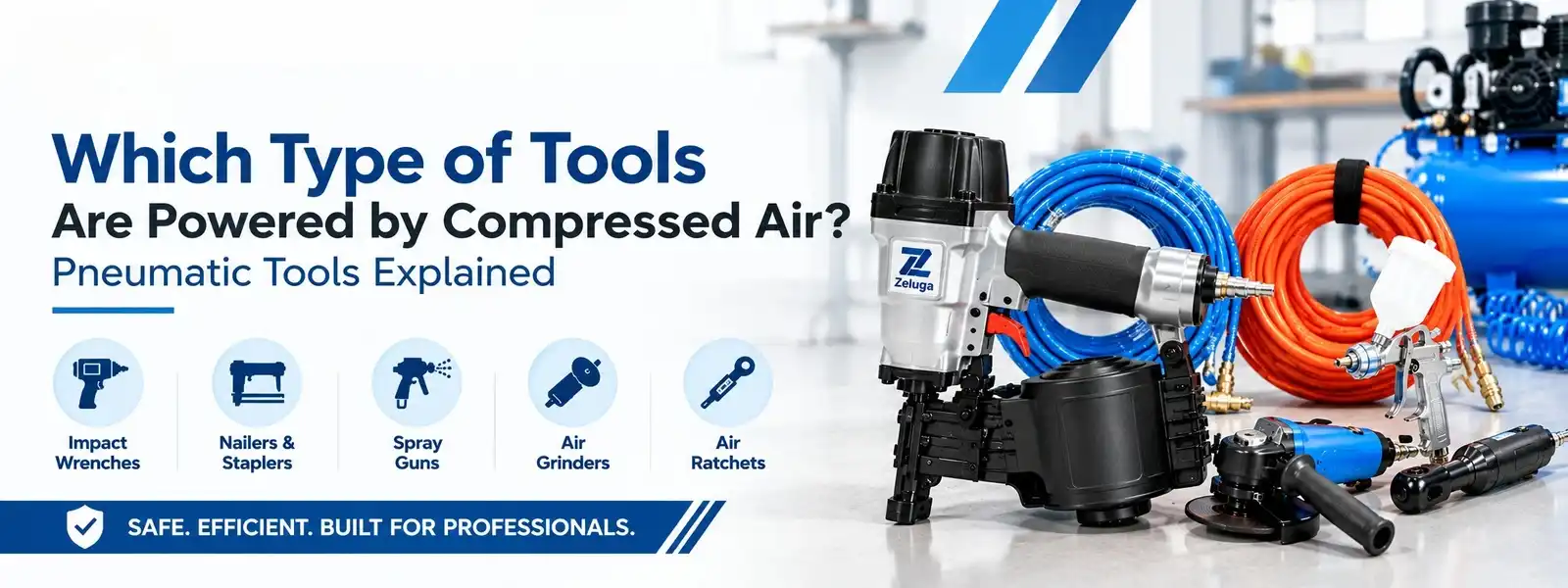
Tools powered by compressed air are called pneumatic tools. If you have used a nail gun, an impact wrench, or a grinder in a shop, you have already used one. A compressor squeezes the air, a hose carries it to your tool, and the air is then turned into motion.
What Are Pneumatic Tools?
Pneumatic tools run on compressed air instead of electricity. Here is how it works: a compressor takes in air and squeezes it into a storage tank. That air is sent through a hose to your tool. When you press the trigger, the air is released and pushes a piston or spins a motor. Tool power is measured in both PSI (pounds per square inch) and CFM (cubic feet per minute).
Types of Tools Powered by Compressed Air
1. Pneumatic Roofing Nailers
A pneumatic roofing nailer is an air-powered tool that shoots nails into shingles. You can reach for it when a large roof must be covered fast. Fast firing and adjustable nail depth are its main strengths. Set your pressure first, press the nose flat on the shingle, and pull the trigger. Never point it at anyone, yourself included.
2. Pneumatic Palm Nailers
A pneumatic palm nailer is a small air tool, held in your palm, that drives nails in tight spots. It is handy between joists and for joist hangers, where a full-size nailer will not fit. Its small size and one-hand use are its strengths. Load the nail, set the tip on the spot, and push down. Keep your fingers clear of the nose.
3. Pneumatic Framing Nailers
A pneumatic framing nailer is a powerful air tool that drives long nails into lumber for frames. You can use it when walls, subfloors, and sheathing need many heavy nails. Fast firing and large nail capacity are its strengths. Adjust the pressure until nails sit flush, press the tip to the wood, and pull the trigger. Wear eye and ear protection.
4. Pneumatic Blow Guns
A pneumatic blow gun is a handheld nozzle that shoots a jet of compressed air. It is handy when you need chips, dust, and coolant cleared off parts and workbenches. Its strengths are instant response and low cost. Squeeze the lever to release air. Under OSHA rule 1910.242(b), cleaning pressure is limited to 30 PSI, and air must never be aimed at skin.
5. Pneumatic Impact Wrenches
A pneumatic impact wrench is a tool that loosens and tightens bolts with short bursts of force. You can use it on lug nuts and suspension bolts. Its strength is high torque (turning force) in a compact body. Fit an impact-rated socket and press the trigger until the bolt is seated. Always check final tightness with a torque wrench.
6. Pneumatic Ratchets
The pneumatic ratchet is a small air powered tool that can be used to quickly remove and fit nuts and bolts by spinning the sockets. This is very useful in areas such as engine bays and underneath dashboards. They are great because of their slim heads and light weight. Simply put the socket on and turn the directional switch. Once the nut/bolt has been fully removed/tightened with the ratchet, finish with a torque wrench.
7. Pneumatic Drills
Drills are air-powered tools that use a spinning bit to drill holes into metal and wood. You can choose to use this if you are worried about sparking and heating of the motor. It is a lightweight tool. Simply attach your drill bit to the chuck, adjust the speed using the trigger and maintain steady pressure. Make sure to fix your material in place using a clamp.
8. Pneumatic Screwdrivers
A pneumatic screwdriver uses compressed air to tighten screws to a pre-set level. These can be found on high volume production lines. The clutch will release when reaching a certain level of torque so they won’t over tighten and strip the head. Choose the right bit, set a torque and screw until you feel the clutch click. Change any worn bits.
9. Pneumatic Grinders
A pneumatic grinder is a high speed tool used to remove material by using a grinding wheel or burr. This can be used to clean welds, deburr, and strip rust. The advantages of a pneumatic grinder are they have a cool running motor and are lightweight. Ensure the wheel is fitted and guards are in place and let the tool run freely until ready to use. Don’t exceed the maximum speed of the wheel.
10. Pneumatic Sanders
Pneumatic sanders are air powered tools used for sanding down surfaces using sanding discs or sheets. They are commonly used during car bodywork and furniture finishing. They produce little heat so they are great for long periods of sanding. The correct grit should be fitted onto the unit, then simply apply light pressure to the surface with a flat sanding pad. Dust extraction and respiratory equipment must be used.
11. Pneumatic Hammers
Pneumatic hammers are air driven tools which deliver fast hammering action. They’re useful to free stuck parts and cut exhaust pipes. They have high speeds of hammering but require little effort from you. Attach the chisel to the retention device and give short bursts of hammering, ensuring you hold the tool firm. Must wear hearing protection.
12. Pneumatic Reciprocating Saws
A pneumatic reciprocating saw is air powered. It uses a saw blade to cut by moving it backwards and forth. It can be used to cut pipes, tear down structures and remove bodywork. Advantages are small and will not cause damage if it jams. Clamp the blade into place. Ensure the shoe is rested against workpiece and slowly pull the trigger. Ensure material is secured.
13. Pneumatic Staplers
Pneumatic staplers are stapling tools that use compressed air to drive the staples into the material. They can be used to staple materials such as upholstery, cabinet backs and subflooring. As these have large staples they are great for covering a large area, and you can fire them quickly. To use simply load the magazine, adjust the pressure, place the nose of the tool on the material you wish to staple and pull the trigger. Take care to keep your hands away from the nose.
14. Pneumatic Riveters
Pneumatic Riveters are air powered tools that pull out a thin pin (called a mandrel) until it snaps to set blind rivets. They can be used on ducting and enclosures. The benefits of using an air powered riveter include consistent clamping forces and reduced fatigue on the users hands. To use simply fit the correct nose piece, insert a rivet and hold down the trigger until the mandrel snaps. Use eye protection.
15. Pneumatic Shears
A Pneumatic Shear is a cutting equipment which uses compressed air to cut through sheet metal quickly. It can be used on body panels, ducting and roof sheets. The advantage of this is the neat cut and minimal distortion. Simply mark your line on the sheet and allow the shear to cut along the line, keeping the trigger pressed. As the blades will create a sharp cut wear gloves.
16. Pneumatic Paint Sprayers
A pneumatic paint sprayer is a type of spray gun that uses compressed air to break paint into a fine mist. It can be used when refinishing cars or cabinets. The advantage is that you will get an even finish. Thin the paint as per the specifications. Set the pressure on the gun and spray in overlapping coats. Make sure you wear a solvent rated respirator.
17. Pneumatic Tire Inflators
A pneumatic inflator consists of a hose with a pressure gauge and chuck. This can be used in tire shops to quickly inflate tires. It has a pressure gauge so you know how much pressure you are using. To use this, attach the chuck to the valve stem, release small amounts of air and check that the pressure matches that on the placard. Don’t over inflate.
18. Pneumatic Grease Guns
Pneumatic grease guns are greasers that work using air to push the grease through to the bearings and fittings. They are useful to use for heavy machinery as there are lots of fittings which will need regular maintenance. The advantages of using a pneumatic grease gun is they are quicker to apply and do not require as much manual effort. To use you attach the coupler to a clean fitting and pull the trigger until new grease comes out. Do not over-grease as this could cause damage to the seals.
19. Pneumatic Caulking Guns
A pneumatic caulking gun uses compressed air to squeeze sealant or adhesive from a cartridge. They are very useful for applications requiring long beads of sealant, such as glazing and panel bonding. The size of the bead can be controlled by pulling the trigger. Insert the cartridge, trim the nozzle and adjust the pressure. Let off the pressure before removing the cartridge.
20. Pneumatic Needle Scalers
This is an air operated tool. It works by hammering a bundle of fine steel needles onto a surface. These can be used to strip away rust, scale and old coatings from steel. They will follow an uneven surface well. You need to use them at a slight angle, moving slowly whilst using. Eye, ear and dust protection should be worn.
21. Pneumatic Sandblasting Equipment
These tools use compressed air to propel abrasive media through a nozzle. They can be used to remove coatings and prepare metal surfaces. They will give you a consistent finish. Ensure you select a nozzle size that is appropriate to your compressor’s CFM rating, and keep a consistent distance. You must wear respiratory protection and avoid using silica sand.
What Equipment Is Needed to Operate Pneumatic Tools?
Air compressor
The compressor is the heart of your setup. Its SCFM output at 90 PSI must exceed the total air use of every tool you run together.
Also Read: Air Hose Explained: Types, Uses & How It Works
Air Compressor Hose Buying Guide: Types, Sizes, Applications & How to Choose the Right
Receiver tank
Compressed air is stored in the receiver tank, which smooths pressure swings and supplies short bursts so your compressor motor does not run nonstop.
Hose and couplers
Match hose width to your tool’s demand, because long or narrow hoses cause pressure drop. Quick couplers must be rated for the same airflow.
FRL unit
An FRL unit holds a filter, regulator, and lubricator. Dirt and water are removed, your pressure is set, and a little oil is added where needed.
Moisture control
Moisture condenses in compressed air as it cools. It is removed by an aftercooler, a dryer, and drain valves, because it causes rust and ruins paint finishes.
Protective equipment
You need ANSI-rated safety glasses, hearing protection, and gloves. Whip checks should also be installed at hose connections to stop a loose hose from lashing around.
How to Choose the Right Pneumatic Tool Define the task
Depending on the task you are needing to achieve, you will need to use a specific type of tool. For example: tightening, screwing, cutting and sanding will require different tools.
Check air use
Every tool in the manual will list how many CFMs it requires to function properly at it’s rated PSI. This should be compared to how much air your compressor provides and allow for some extra air to account for any leaks.
Match torque or force
Check the foot-pounds, nail size or free speed (RPM) to ensure it matches the task. Going too big will cause unnecessary air consumption and reduce your control significantly.
Think about all-day use
If you are going to be using your tool for extended periods of time then weight, vibration and noise levels will play an important part. Tired hands lose accuracy very quickly.
Confirm serviceability
Before purchasing ensure there are replacement parts available, rebuild kits and warranty information. If you cannot repair your tool quickly it will cause you real downtime.
Pneumatic Tools vs. Electric Tools
| Factor | Pneumatic tools | Electric tools |
| Power source | Compressed air from a compressor | Mains power or battery |
| Weight | Lighter body, since the motor is simple | Heavier, due to the motor or battery |
| Overload | Can be stalled without motor burnout | Motor can overheat under sustained load |
| Sparking | No electric motor in the tool | Sparks can occur at the motor and switch |
| Cost | Tool is often cheaper, but compressor and hose add cost | Price varies; no air system is needed |
| Mobility | Limited by hose length and compressor location | Limited by cord length, or free with a battery |
| Noise | Higher, from exhaust air and the compressor | Generally lower |
| Maintenance | Oiling, filters, and moisture drainage | Brushes and battery care |
Key Takeaways
- Pneumatic tools are driven by compressed air, supplied by a compressor and delivered through a hose.
- PSI determines force, and CFM determines how long that force can be sustained.
- Nailers, wrenches, grinders, sanders, drills, and sprayers all run on the same air system.
- A correctly sized compressor, receiver tank, hose, and FRL unit protect your tool’s performance.
- Moisture control extends tool life and prevents finish defects.
- Eye, ear, and respiratory protection must be matched to the tool you are using.
- Your task, air use, torque, duty, and serviceability should drive every purchase.
FAQs
What Is the Most Commonly Used Pneumatic Tool?
Impact wrenches and nailers are used in almost every automotive and building site.
Do All Pneumatic Tools Require an Air Compressor?
Yes, they require compressed air. This can be supplied via an air compressor, air line from the plant or using a cylinder.
What Is the Difference Between Pneumatic Tools and Air Tools?
There is no difference. Air tool is just what people call them in the shop. Pneumatic is the technical term.
Can Pneumatic Tools Be Used for Continuous Industrial Work?
Yes. With the correct sized compressor and air treatment equipment, industrial tools can be used throughout a full shift.
How Do PSI and CFM Affect Pneumatic Tool Performance?
PSI indicates how hard your tool will work and CFM indicates how long it can for. If you have a low CFM you will lose power.