

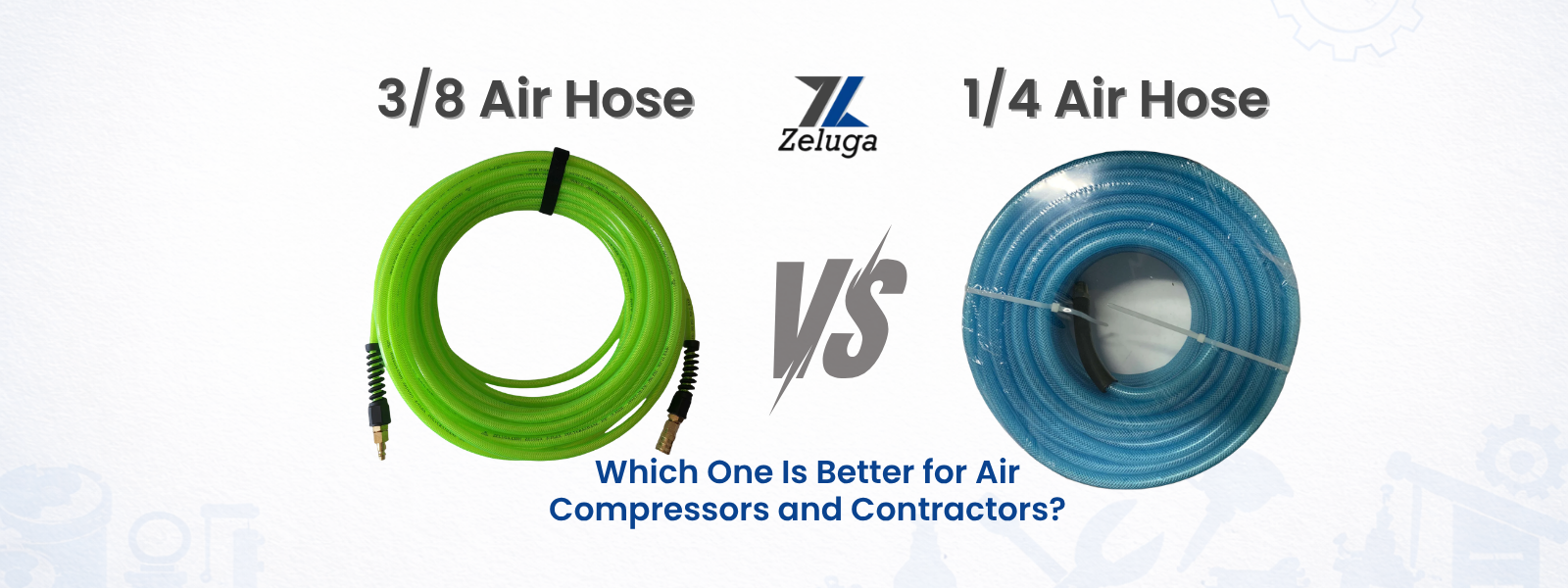
Many contractors, mechanics, roofers, and workshop owners struggle when choosing between a 1/4 air hose and a 3/8 air hose. While both sizes are widely used with air compressors, they serve different purposes depending on the air demand of your tools.
At Zeluga, we offer a variety of air hose solutions, including 1/4 air hose and 3/8 Air Hose, designed for contractors, roofers, and industrial users throughout the USA.
Choosing the wrong air compressor hose can reduce tool performance, increase pressure drop, and create unnecessary frustration on the job site.
What Does Air Hose Size Mean?
Inner Diameter (ID)
The inner diameter determines how much compressed air can move through the hose. A larger diameter generally supports greater airflow capacity.
Outer Diameter (OD)
Outer diameter includes the hose wall thickness and influences durability, handling characteristics, and compatibility with storage systems.
Airflow Capacity
The larger the hose diameter, the more compressed air flow can pass through the system with reduced restriction.
Pressure Delivery
Hose size affects air delivery efficiency. Selecting the correct diameter helps maintain consistent pressure at the tool.
Why Hose Diameter Matters
The right pneumatic hose size improves productivity, reduces PSI loss, supports better air tool performance, and maximizes compressor efficiency.
What Is a 1/4 Air Hose?
A 1/4 air hose is one of the most common sizes used with pneumatic tools. It is widely used as an air hose for compressor systems in roofing, finishing, maintenance, and workshop applications. The smaller internal diameter helps keep the hose lightweight and easy to manage.
Typical hose lengths range from 25 feet to 100 feet depending on the application. Many contractors prefer this size because it offers good flexibility while remaining practical for everyday pneumatic work. Zeluga supplies multiple hose options suitable for users who prioritize mobility and ease of handling.
Advantages of a 1/4 Air Hose
- Lightweight and comfortable for all-day use on active job sites.
- Easier to carry across roofs, ladders, and construction areas.
- Flexible design supports improved movement around equipment and structures.
- Lower overall cost compared with larger hose sizes.
- Excellent for roofing work using nail guns and lighter pneumatic tools.
Disadvantages of a 1/4 Air Hose
- Lower airflow volume compared with larger hose diameters.
- Not ideal for tools with high cubic feet per minute requirements.
- Greater pressure drop may occur during longer hose runs.
What Is a 3/8 Air Hose?
A 3/8 air hose is designed to deliver greater airflow than smaller hose sizes. The larger internal diameter allows more air volume delivery to reach pneumatic tools, making it suitable for demanding applications. A 3/8 inch air hose is commonly used where airflow rate, tool performance, and reduced pressure drop are priorities.
Contractors, fabrication shops, automotive facilities, and industrial users often select a 3/8 air hose when operating tools with higher CFM rating requirements. Zeluga offers reinforced polyurethane hose solutions in 3/8-inch configurations for professional users seeking dependable performance.
Advantages of a 3/8 Air Hose
- Higher airflow supports demanding pneumatic equipment.
- Better suited for high air demand tools.
- Reduced pressure drop during operation.
- Longer hose runs possible without significant airflow restrictions.
Disadvantages of a 3/8 Air Hose
- Heavier than smaller hose sizes.
- Slightly less flexible in some applications.
- Higher purchase cost.
- Can be harder to manage on roofing projects.
1/4 Air Hose vs 3/8 Air Hose: Comparison
| Feature | 1/4 Air Hose | 3/8 Air Hose |
| Weight | Very Light | Heavier |
| Flexibility | Excellent | Good |
| Airflow | Moderate | High |
| Pressure Drop | Higher | Lower |
| Tool Compatibility | Small-Medium Tools | High-Demand Tools |
| Portability | Excellent | Average |
| Cost | Lower | Higher |
| Roofing Work | Excellent | Good |
| Automotive Shops | Good | Excellent |
| Construction Sites | Good | Excellent |
Airflow Differences Between 1/4 and 3/8 Air Hoses
Airflow is often measured using cubic feet per minute. Tools with higher CFM requirements need more air delivered consistently through the hose. A larger hose diameter allows greater airflow while reducing restriction within the compressed air system.
For example, a framing nailer or roofing nailer typically works effectively with smaller hose sizes because air demand remains relatively moderate. However, an impact wrench, air grinder, or air sander airflow needs may exceed what smaller hoses deliver efficiently.
In those situations, a 3/8 air hose often helps maintain better airflow and supports improved compressor efficiency. Matching hose size to tool demand is one of the most important factors when selecting air hoses for air compressor systems.
Which Air Tools Work Best with a 1/4 Air Hose?
A 1/4 air hose is commonly used with tools that require moderate airflow and prioritize portability. Popular applications include:
- Roofing Nailers
- Brad Nailers
- Finish Nailers
- Staplers
- Light-Duty Pneumatic Tools
- General Maintenance Work
- Mobile Service Applications
- DIY Pneumatic Projects
These tools generally benefit from a lightweight hose that is easy to move around active work areas.
Which Air Tools Need a 3/8 Air Hose?
Impact Wrenches
Require higher airflow volumes to maintain consistent torque output during demanding fastening applications.
Air Sanders
Continuous airflow demand makes larger hose diameters beneficial for performance and productivity.
Air Grinders
High air consumption rates often make larger hose sizes the preferred choice.
Paint Sprayers
HVLP spray gun hose setups frequently benefit from improved airflow delivery.
Industrial Pneumatic Equipment
Many industrial applications require higher air volume and consistent delivery.
High-CFM Tools
Tools with significant airflow demands perform more efficiently with larger hose diameters.
Pressure Drop: Why Hose Size Makes a Difference
What Causes Pressure Loss?
Pressure drop occurs when airflow encounters resistance while moving through the hose system.
Length vs Diameter
Longer hose runs increase restriction. Larger diameters help reduce pressure loss over distance.
Air Restriction
Smaller diameters may create additional flow restriction when air demand increases significantly.
Tool Performance Effects
Insufficient airflow can reduce tool efficiency, speed, and overall productivity.
Energy Efficiency
Reducing unnecessary restriction helps compressors operate more efficiently while maintaining desired output levels.
Best Air Hose Size for Construction Professionals
Construction professionals often use a wider variety of pneumatic tools than roofing specialists. Framing crews, commercial contractors, and industrial users may operate tools with higher airflow demands. In these environments, a 3/8 air hose frequently provides advantages by supporting increased air volume delivery and reducing pressure drop across longer hose runs.
The ideal choice depends on tool requirements, hose length, compressor tank size, and job-site conditions. Many contractors keep both hose sizes available to accommodate different equipment and applications.
How to Choose the Right Air Hose Size
Compressor Output (CFM)
Review air compressor output and compare it against tool airflow requirements before selecting a hose size.
Tool Requirements
High-demand tools often require larger hose diameters to maintain consistent airflow and performance.
Hose Length
Longer hose runs increase friction loss and may justify selecting a larger diameter.
Job Site Conditions
Consider portability, movement requirements, and working environments before making a decision.
Portability Needs
Mobile users often prioritize lighter hoses that are easier to transport and manage.
Budget
Balance performance requirements against cost to identify the most practical solution.
Zeluga Air Hose Solutions for Contractors
Zeluga 1/4 Air Hose
Built for demanding contractors requiring durability, airflow efficiency, and reliable pneumatic performance.
- 21-310 1/4in. x 100ft. PVC Transparent Air Hose, Transparent Yellow
- 21-311 1/4in. x 100ft. PVC Transparent Air Hose, Transparent Green
- 21-312 1/4in. x 100ft. PVC Transparent Air Hose, Transparent Blue
- 21-309 1/4in. x 100ft. PVC Transparent Air Hose, Transparent Red
Zeluga 3/8 Air Hose
Zeluga 21-485 Z-Flex Reinforced Polyurethane Air Hose 300 PSI, 3/8″ ID
Designed for contractors and industrial users who need extended reach without sacrificing airflow. T
- Available in 100 ft length & 50 ft length
- 3/8″ ID for higher airflow delivery
- Reinforced polyurethane construction
- 300 PSI working pressure
- 100ft length for larger job sites
- Includes 6-ball coupler and safety plug
Common Air Hose Mistakes to Avoid
- Buying based only on price rather than application requirements.
- Ignoring tool CFM requirements before selecting hose diameter.
- Choosing excessive air hose length that increases friction loss.
- Using incorrect air hose fittings or quick connect couplers.
- Selecting the wrong material for the operating environment.
Need Help Choosing the Right Air Hose Size for Your Application?
Whether you need a lightweight 1/4 air hose for roofing projects or a high-flow 3/8 air hose for demanding pneumatic tools, Zeluga offers professional air hose solutions designed for contractors, workshops, distributors, and industrial users.
Our range includes reinforced polyurethane hoses, flexible Z-Lite hose systems, and PVC air hose options built for different airflow requirements.
Contact Zeluga today to find the right hose size, material, and configuration for your air compressor system and daily work environment.
Conclusion
The decision between a 1/4 air hose and a 3/8 air hose depends on airflow requirements, tool demand, and working conditions. A 1/4 air hose is often the preferred choice for portability, roofing work, finish applications, and lighter pneumatic tools. A 3/8 air hose is better suited for maximum airflow, demanding equipment, and higher-CFM applications.
Understanding tool requirements, hose length, compressor capacity, and airflow demand is the key to making the right choice. Zeluga provides reinforced polyurethane and PVC air hose solutions designed to support contractors, workshops, distributors, and industrial users across a wide range of professional applications.
Frequently Asked Question
Is a 1/4 air hose big enough for an air compressor?
Yes. Many nailers, staplers, and lighter pneumatic tools operate effectively with a 1/4-inch hose.
When should I use a 3/8 air hose?
Use it when operating tools that require higher airflow and greater air volume delivery.
Does a larger air hose increase pressure?
No. It helps reduce restriction and pressure loss but does not increase compressor pressure.
What is the best air hose size for roofing?
Many roofing contractors prefer 1/4-inch hoses because they are lightweight and easy to manage.
Which air hose size is best for impact wrenches?
Impact wrenches often perform best with larger hose diameters that support higher airflow.
Is polyurethane better than PVC?
Both have advantages. Polyurethane generally offers greater flexibility and durability for contractors.
How long should an air compressor hose last?
Lifespan depends on usage, environment, material quality, and maintenance practices.
Which Zeluga air hose is best for contractors?
Many contractors choose Zeluga Z-Lite and Z-Flex polyurethane hose products depending on airflow requirements.