

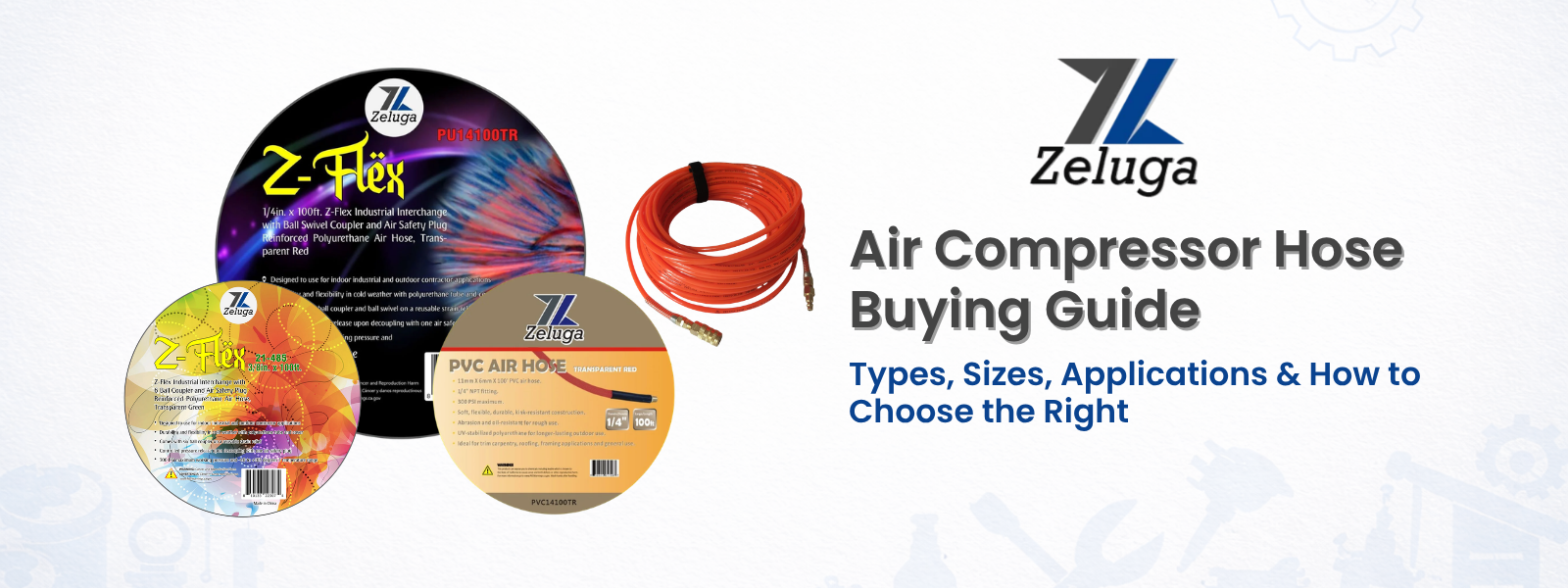
Choosing the right air compressor hose is one of the most important decisions before using pneumatic tools, compressors, and compressed air systems. Many focus only on price and overlook factors such as material, hose size, reinforcement, working pressure, and application requirements. This often leads to airflow loss, pressure drop, kinking, reduced tool efficiency, and premature hose failure.
As a leading manufacturer and supplier of air hoses in the USA, Zeluga offers multiple hose solutions designed for contractors, distributors, workshops, and industrial users. Our suggestion is straightforward: material matters, size matters, reinforcement matters, and application matters.
What is Air Compressor Hose?
An air compressor hose, also known as pneumatic tubing or a compressed air hose, is used for pressurised air transfer between an air compressor and pneumatic tools. The hose delivers air pressure from the compressor to the operating equipment while maintaining airflow and working pressure.
These hoses are commonly used in aeronautical engineering, mechanical engineering, chemical production, food manufacturing, workshops, and construction projects.
Air hoses are available in different materials, diameters, pressure ratings, and lengths. Choosing the correct hose helps improve efficiency, safety, airflow consistency, and overall tool performance.
How to Choose the Right Air Compressor Hose in 4 Steps
Choose Material
Polyurethane
Lightweight, flexible, kink-resistant, and easy to handle. Popular among contractors, roofers, and professionals requiring mobility and durability.
PVC
Affordable, lightweight, easy to store, and suitable for general-purpose compressed air applications in workshops and garages.
Read More: Polyurethane vs PVC Air Hose: Which One Is Better for Contractors, Air Compressors & Industrial Use?
Choose Construction
Reinforced
Designed for higher working pressure, increased durability, improved abrasion resistance, and demanding contractor or industrial applications.
Non-Reinforced
Lighter and more flexible, making it suitable for service technicians, workshops, and applications requiring easier handling.
Read More : Wire Reinforced vs Non-Reinforced Air Hose: Which One Is Better for Air Compressors and Contractors?
Choose Hose Size
1/4″
Common choice for roofing, finish work, nail guns, and portable pneumatic tools requiring moderate airflow.
3/8″
Provides greater airflow capacity and is suitable for impact tools, grinders, and higher-demand pneumatic equipment.
Read More: 1/4 Air Hose vs 3/8 Air Hose: Which Size Should You Choose for Air Compressors?
Choose Application
Roofing
Requires lightweight and flexible hoses that are easy to move across roofs and scaffolding.
Construction
Benefits from durable hose designs capable of handling demanding job-site conditions and daily use.
Workshop
Focuses on reliable airflow, easy storage, and cost-effective operation for general maintenance tasks.
Industrial
Often requires reinforced hose systems capable of supporting higher airflow demands and continuous operation.
Why Choosing the Right Air Compressor Hose Matters
Better Productivity
The correct hose allows tools to operate efficiently, reducing downtime and helping workers complete tasks faster without unnecessary interruptions.
Consistent Airflow
Proper hose selection helps maintain stable airflow from the compressor to the tool, supporting reliable operation throughout the workday.
Pressure Retention
Choosing the correct internal diameter and hose length reduces pressure drop and helps maintain desired working pressure.
Improved Safety
Quality hoses reduce the risk of leaks, failures, and unexpected interruptions that may create workplace hazards.
Better Tool Efficiency
Pneumatic tools perform best when supplied with adequate airflow and pressure through a properly selected hose system.
Types of Air Compressor Hoses
Polyurethane Air Compressor Hose
A polyurethane air hose is one of the most popular options among contractors and professional users. It combines flexibility, durability, and lightweight handling, making it suitable for demanding environments. Polyurethane resists kinking better than many alternative materials and remains easy to maneuver in active working areas.
Zeluga provides polyurethane hose, including Z-Flex Reinforced Air Hose models and Z-Lite Air Hose. The Orange Air Hose and Blue Air Hose options are designed for users seeking mobility and ease of use.
These hose systems are commonly selected for roofing, framing, maintenance, and contractor applications where flexibility and reliability are important.
PVC Air Compressor Hose
A PVC air hose offers a practical and cost-effective solution for many compressed air applications. It is lightweight, easy to store, and widely used in workshops, garages, and general maintenance environments. PVC hoses provide dependable airflow while remaining affordable for users managing larger hose inventories.
Zeluga offers PVC Red, PVC Green, PVC Blue, and PVC Yellow hose options that support various workshop and pneumatic applications. These hoses are commonly used where flexibility requirements are moderate and buyers seek dependable performance at an economical price point.
Polyurethane vs PVC Air Compressor Hose
| Feature | Polyurethane Air Hose | PVC Air Hose |
| Flexibility | Excellent | Good |
| Weight | Very Light | Light |
| Durability | Excellent | Good |
| Kink Resistance | Excellent | Average |
| Outdoor Use | Excellent | Good |
| Contractor Use | Excellent | Good |
| Cost | Higher | Lower |
Read More: Polyurethane vs PVC Air Hose: Which One Is Better for Contractors, Air Compressors & Industrial Use?
Reinforced vs Non-Reinforced Air Compressor Hoses
Reinforced hose constructions contain additional support layers that improve strength, durability, and resistance to demanding operating conditions.
These hose designs are commonly selected for construction projects, industrial operations, and applications where higher working pressure or increased durability is required. Zeluga’s reinforced hose range supports professional users who need dependable long-term performance.
Non-reinforced hose constructions focus on flexibility and lightweight handling. These products are easier to transport, store, and maneuver around job sites.
Workshops, service technicians, and users prioritizing portability often choose non-reinforced designs because they offer practical airflow performance while remaining easy to use throughout the working day.
Read More : Wire Reinforced vs Non-Reinforced Air Hose: Which One Is Better for Air Compressors and Contractors?
Air Compressor Hose Sizes Explained
Choosing the correct air hose size is critical because hose diameter directly affects airflow, pressure retention, portability, and overall tool performance. The internal diameter (ID) determines how much compressed air can pass through the hose. A larger internal diameter generally allows greater airflow, while a smaller diameter offers improved portability and lighter weight.
1/4 Air Hose
A 1/4-inch hose is one of the most common options used by contractors, roofers, and maintenance professionals. It offers an excellent balance between flexibility and airflow. The lighter weight makes it easier to move around roofs, ladders, and working areas. This size is commonly used with nail guns, staplers, finish tools, and general pneumatic equipment.
3/8 Air Hose
A 3/8-inch hose provides greater airflow capacity and is often selected for tools with higher air consumption. Zeluga 21-484 and Zeluga 21-485 reinforced polyurethane hoses feature 3/8-inch internal diameter designs suitable for demanding pneumatic applications. These hoses are commonly used with impact wrenches, grinders, and industrial tools requiring higher airflow.
The Zeluga PVC series and polyurethane product range allow buyers to select the most suitable hose size based on airflow demand, mobility requirements, and application needs.
Understanding Air Pressure, CFM & Airflow Requirements
PSI and Working Pressure
PSI measures the air pressure delivered through the hose. Every hose has a working pressure rating and a bursting pressure rating that must be considered before selection.
CFM and Air Demand
CFM (Cubic Feet per Minute) measures airflow volume. Tools with higher CFM requirements need hose systems capable of delivering adequate airflow consistently.
Compressor Output Matters
Air compressor output should always match the airflow demand of connected pneumatic tools. Insufficient output can reduce tool performance.
Pressure Loss and Restrictions
Pressure drop occurs when airflow encounters resistance caused by hose length, bends, fittings, or undersized hose diameter.
Tool Requirements Vary
A nail gun typically requires less airflow than an air impact wrench, air grinder, or industrial blow gun. Understanding these differences is essential.
Real-World Application
Paint sprayers, shot blasting equipment, and larger pneumatic systems often require higher airflow than standard maintenance tools. Selecting the correct hose prevents performance issues and unnecessary compressor strain.
How Air Hose Length Affects Performance
25ft Hose Applications
Shorter hose lengths generally provide better airflow efficiency because compressed air travels a shorter distance with less resistance.
50ft Hose Applications
A 50-foot hose balances mobility and airflow performance. Zeluga 21-484 reinforced hose products are commonly selected in this category.
100ft Hose Applications
Longer hose systems provide greater reach across larger workspaces. Zeluga 21-485 and PVC hose products support extended operating distances.
Pressure Drop Considerations
As the hose becomes longer, pressure drop increases. The longer the hose, the more airflow resistance develops throughout the system.
Mobility vs Efficiency
Buyers should balance working area requirements with airflow performance. Excessive hose length may reduce efficiency if not properly sized.
Common Air Compressor Hose Applications
Roofing
Roofing contractors rely on lightweight hose systems for nail guns and pneumatic tools. Flexibility and portability are often the primary priorities.
Framing
Framing crews frequently use compressed air equipment throughout the day. Durable hose systems help support productivity and reliability.
Construction
Construction environments require hose solutions capable of handling abrasion, daily movement, and demanding operating conditions.
Workshops
Workshops use air hoses for maintenance, repairs, inflation tasks, and various pneumatic tools. Ease of storage is often important.
Manufacturing
Many manufacturing facilities depend on pressurised air transfer systems to support production equipment and automated processes.
Maintenance Operations
Maintenance professionals require flexible hose solutions that can move easily between workstations and service areas.
Best Air Compressor Hose for Roofing Contractors
For roofing contractors, lightweight handling and flexibility are usually more important than maximum airflow capacity. A polyurethane hose often provides the best balance between durability and portability.
Zeluga Z-Lite hose products are specifically suited for contractor mobility, helping users move efficiently across roofs while maintaining reliable airflow for roofing nailers and other pneumatic tools.
Read More: Best Air Hose Manufacturer & Supplier in USA – Zeluga
Best Air Compressor Hose for Construction Projects
Construction projects often involve demanding environments where hose durability becomes critical. Reinforced hose systems provide additional strength and abrasion resistance.
Zeluga Z-Flex reinforced polyurethane hose products are designed for construction professionals who require dependable performance, durability, and consistent airflow throughout extended work periods.
Best Air Compressor Hose for Workshops and Garages
Workshops and garages often prioritize practicality and value. PVC hose systems are frequently selected because they offer dependable performance while remaining cost-effective. Zeluga PVC hose products in Red, Green, Blue, and Yellow provide reliable airflow solutions suitable for general workshop and maintenance applications.
Common Problems with Air Compressor Hoses
Kinking Issues
Frequent bending can restrict airflow and reduce hose performance, particularly when lower-quality hose materials are used.
Cracking Over Time
Exposure to demanding environments, improper storage, and aging materials may eventually lead to hose cracking.
Abrasion Damage
Dragging hoses across rough surfaces can wear outer layers and reduce overall service life.
Air Leaks
Damaged hose fitting connections and worn components can cause air leaks that reduce efficiency.
Pressure Loss
Improper hose sizing, excessive length, and restrictive fittings may contribute to unwanted pressure drop.
Air Hose Couplers and Fittings: Why They Matter
Brass Couplers
Brass fittings provide durable and dependable connections between compressors, hoses, and pneumatic tools.
Ball Swivel Couplers
These couplers help reduce hose twisting while improving movement and user convenience during operation.
Air Safety Plugs
Safety plugs support secure connections and help improve workplace safety when disconnecting pneumatic systems.
Hose Splicers
Hose splicers connect sections of hose and help extend or repair compressed air systems.
Proper Compatibility
Whether using a BSPT fitting, PCL coupling, NPT connector, or quick-release coupling, selecting compatible fittings is essential. Zeluga offers accessories designed to support reliable compressed air performance.
Read More : Air Hose Fittings Types: Complete Guide & Uses
Which Zeluga Air Hose Should You Choose?
| Application | Recommended Product |
| Roofing | Zeluga Z-Lite Air Hose |
| Construction | Zeluga Z-Flex Reinforced Air Hose |
| Workshops | Zeluga PVC Air Hose Series |
| Industrial | Reinforced Polyurethane Air Hose |
| Mobile Technician | Zeluga Z-Lite Air Hose |
| High Airflow Tools | 3/8″ Zeluga Z-Flex Reinforced Air Hose |
Key Takeaways
- Material selection affects flexibility, durability, and overall performance.
- Polyurethane is often preferred by contractors and mobile users.
- PVC offers dependable performance at a cost-effective price.
- Reinforced hose systems support demanding environments.
- Non-reinforced hoses prioritize flexibility and portability.
- Zeluga provides solutions for roofing, construction, workshops, and industrial applications.
Talk to Zeluga for Bulk Purchase Requirement
Whether you need a lightweight polyurethane hose for roofing projects, a reinforced hose for construction work, or a reliable PVC solution for workshop applications, Zeluga offers air hose systems designed for professional performance.
Our team supports distributors, wholesalers, contractors, and industrial buyers with quality hose solutions, fittings, and accessories. Contact Zeluga today to discuss product selection, bulk purchasing requirements, and the best hose configuration for your specific application.
FAQs
What is the best air compressor hose material?
Polyurethane is often preferred for flexibility and durability, while PVC provides a practical and economical alternative.
Is polyurethane better than PVC for air compressor hoses?
For contractor mobility and demanding applications, polyurethane often offers advantages in flexibility and durability.
What size air compressor hose should I use?
The correct size depends on tool airflow demand, hose length, and compressor output requirements.
Is a 1/4 air hose suitable for roofing work?
Yes. Many roofing contractors use 1/4-inch hoses because they are lightweight and easy to handle.
What is a compressed air hose?
A hose designed to transfer compressed air between compressors and pneumatic equipment.
What is the difference between reinforced and non-reinforced hoses?
Reinforced hoses provide greater durability, while non-reinforced hoses prioritize flexibility and lighter weight.
Which Zeluga air hose is best for contractors?
Many contractors prefer Zeluga Z-Lite and Z-Flex polyurethane hose solutions depending on application requirements.
How long should an air compressor hose last?
Service life depends on material quality, operating conditions, maintenance practices, and application demands.