

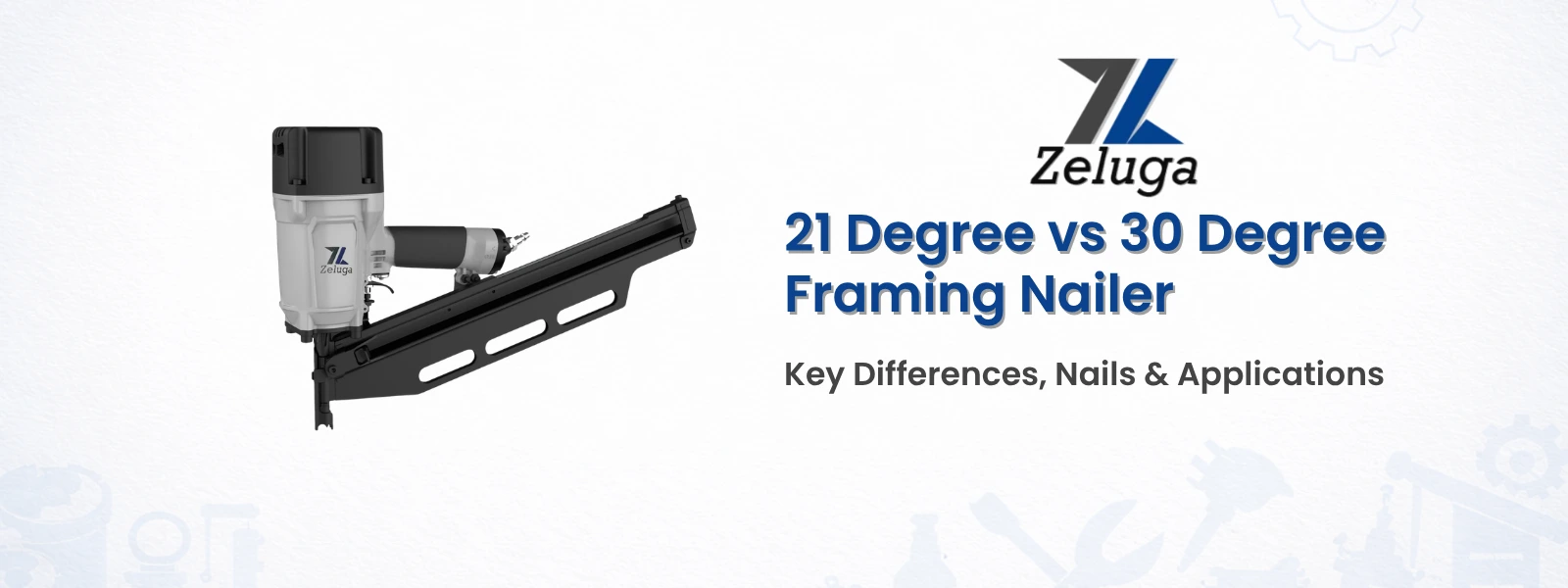
One of the biggest decision while buying a Framing Nailer is choosing between a 21 degree and a 30 degree framing nailer. At first they may look similar. However they use different nail strips and offer different advantages on the job site.
The right choice depends on your projects your working style and the type of framing you do every day. This guide explains the real differences both type of framing nailers, so you can confidently choose the framing nailer that fits your work.
Why Framing Nailers Come in Different Angles?
What Does the Degree Mean?
The degree refers to the angle at which the nails are held inside the magazine. It does not describe the angle at which the nail enters the wood. Many professionals who are buying their first framing nailer often misunderstand this difference.
Why Different Nail Angles Exist
Different nail angles allow manufacturers to design magazines with different shapes and capacities. This changes how easily the tool fits into work areas how many nails it carries and which nail strips it accepts.
Magazine Design Affects Performance
The magazine angle changes the overall shape of the framing nailer. Some designs provide a more compact profile while others focus on carrying more nails for longer uninterrupted work between reloads.
Different Jobs Have Different Needs
Not every framing project requires the same tool. Wall framing roof decking floor framing and working inside narrow spaces all create different demands. That is why multiple framing nailer angles continue to exist.
Nail Collation Determines Compatibility
Each framing nailer is designed for a specific nail collation system. Using the correct nail type ensures reliable feeding consistent driving performance and fewer interruptions during demanding framing applications.
21 Degree vs 30 Degree Framing Nailer: Key Differences
| Feature | 21 Degree Framing Nailer | 30 Degree Framing Nailer |
| Nail Type | Plastic collated framing nails | Paper collated framing nails |
| Nail Head | Full round-head nails | Offset round-head or full round-head depending on nail type |
| Magazine Capacity | Moderate capacity | Higher capacity in many models |
| Reload Frequency | Slightly more frequent | Less frequent due to larger nail strips |
| Access in Tight Areas | Good | Better because of steeper magazine angle |
| Structural Framing | Excellent | Excellent where compatible |
| Floor Framing | Excellent | Suitable |
| Wall Framing | Excellent | Excellent |
| Roof Decking | Excellent | Excellent |
| Wall Sheathing | Excellent | Excellent |
| Deck Building | Excellent | Excellent |
| Building Code Considerations | Often preferred where full round-head nails are specified | Always verify local requirements before use |
| Best For | Structural framing general construction residential building | Tight framing locations production framing and extended fastening runs |
What Is a 21 Degree Framing Nailer?
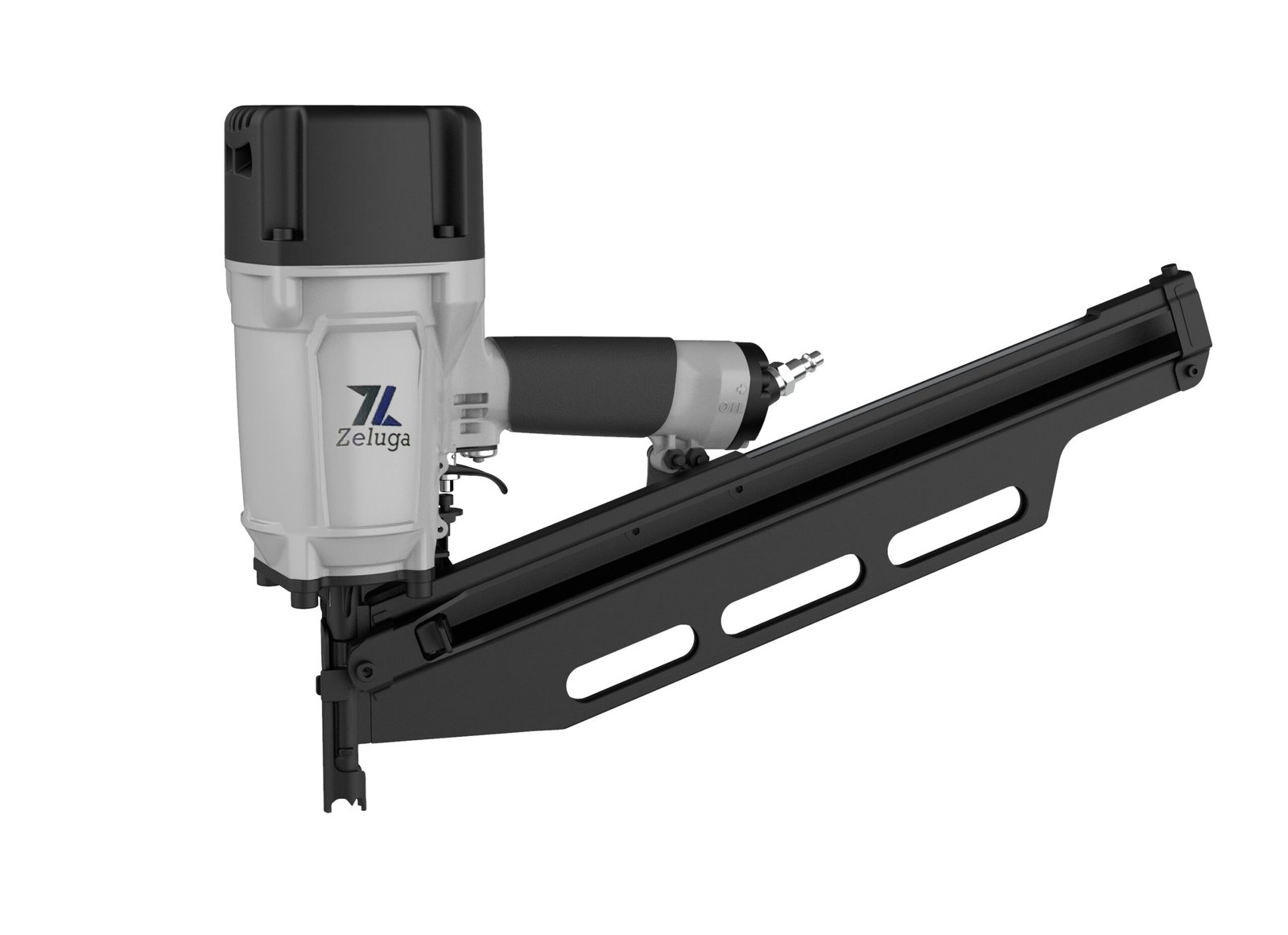
A 21 degree framing nailer is designed to drive plastic collated full round-head framing nails. It is widely used for structural framing because it delivers dependable fastening performance across many construction applications. Contractors often choose this type when working on projects that require strong wood connections and consistent driving power.
Uses Full Round-Head Nails
Most 21 degree framing nailers are designed for full round-head framing nails. These nails provide a large bearing surface that creates secure connections across many structural woodworking applications.
Designed for Structural Framing
This framing nailer is commonly selected for projects where strong fastening matters. It performs well during wall framing floor framing roof decking sheathing and similar structural construction work.
Suitable for Hardwood and Softwood
Whether you are fastening hardwood or softwood framing members a quality 21 degree framing nailer delivers consistent nail driving performance when paired with the correct compressor and compatible framing nails.
Built for Everyday Construction
Professional contractors often rely on 21 degree framing nailers because they perform well across different residential and commercial framing projects without requiring multiple specialty nailers.
Easy to Learn and Operate
For professionals moving into framing work a 21 degree framing nailer offers a straightforward operating experience. Once you understand nail compatibility and air pressure settings it quickly becomes an efficient everyday tool.
What Is a 30 Degree Framing Nailer?
A 30 degree framing nailer uses a steeper magazine angle that allows the tool to reach narrower work areas more easily. It commonly uses paper collated framing nails and is often selected for framing tasks where access and magazine capacity are important considerations.
Uses Paper Collated Nails
Most 30 degree framing nailers are designed to work with paper collated framing nails. These nail strips are compact which allows more nails to fit inside the magazine.
Compact Magazine Design
The steeper magazine angle creates a slimmer profile. This helps when fastening inside corners between closely spaced framing members or other restricted work areas.
Higher Nail Capacity
Many 30 degree framing nailers carry more nails in each magazine. This can reduce reload frequency during large framing projects and improve overall workflow efficiency.
Suitable for Production Framing
Some contractors prefer this design for repetitive framing work where maintaining productivity and reducing interruptions throughout the day are important priorities.
Designed for Confined Work Areas
When framing around obstacles or working where space is limited the narrower magazine design can provide better positioning without changing the overall fastening performance.
Key Differences Between 21° and 30° Framing Nailers
Nail Collation
A 21 degree framing nailer typically uses plastic collated framing nails while a 30 degree framing nailer commonly uses paper collated nails. The nail collation system determines which nails the tool can safely and reliably use.
Nail Head Compatibility
A 21 degree framing nailer is commonly associated with full round-head framing nails. A 30 degree framing nailer may use offset round-head or full round-head nails depending on the nail system designed for that model.
Magazine Capacity
Because of the steeper magazine angle many 30 degree framing nailers hold more nails before reloading. A typical 21 degree framing nailer carries fewer nails but still provides excellent productivity for most structural framing applications.
Reload Frequency
If your projects involve continuous fastening over long periods a larger magazine may reduce reload interruptions. For many residential framing jobs however reload frequency rarely becomes a major productivity concern.
Maneuverability
The slimmer magazine found on many 30 degree framing nailers makes it easier to reach confined framing areas. A 21 degree framing nailer still performs well across most open framing and structural construction tasks.
Weight and Balance
Overall tool weight depends on the manufacturer rather than the magazine angle alone. A well-balanced framing nailer reduces operator fatigue and improves control throughout long working days.
Productivity
Both framing nailers deliver excellent productivity when matched with the right application. Choosing the correct tool for your projects usually has a greater impact than focusing only on magazine capacity.
Holding Performance
Strong fastening depends on proper nail selection correct installation and compatible framing materials. Both framing nailer types provide reliable performance when used with the appropriate framing nails and recommended operating conditions.
Job Site Cleanliness
Plastic collated nails may leave small plastic fragments after fastening while paper collated nails produce different waste. Good housekeeping practices help maintain a clean and safe construction environment.
Moisture Resistance of Collated Nails
Plastic collated nail strips generally handle damp job site conditions well. Paper collated nails should be stored carefully because excessive moisture may affect the integrity of the nail strip before use.
Best Applications for a 21 Degree Framing Nailer
Floor Framing
A 21 degree framing nailer provides dependable fastening for floor joists rim boards and structural floor assemblies. Its compatibility with full round-head nails makes it a reliable choice for demanding flooring construction.
Wall Framing
Wall framing requires consistent fastening across studs plates and headers. A 21 degree framing nailer delivers strong connections while maintaining productivity during residential and commercial framing projects.
Roof Decking
Roof decking involves repetitive fastening over large areas. A 21 degree framing nailer provides reliable nail driving performance that supports efficient installation of roof sheathing and structural decking materials.
Wall Sheathing
Installing wall sheathing requires accurate and consistent fastening. A 21 degree framing nailer helps secure panels efficiently while maintaining dependable fastening strength across exterior wall assemblies.
Truss Assembly
Roof trusses demand accurate fastening between multiple framing members. A 21 degree framing nailer provides the consistent driving performance needed during truss assembly and structural woodworking applications.
Best Applications for a 30 Degree Framing Nailer
Tight Framing Areas
A 30 degree framing nailer offers better access inside narrow framing locations. The steeper magazine angle helps you position the tool more easily between closely spaced studs joists and other framing members.
High-Volume Production Framing
If your crew performs repetitive framing throughout the day fewer reloads can improve workflow. Higher magazine capacity helps reduce interruptions during continuous production framing operations.
Frequent Overhead Work
When working overhead a slimmer magazine can sometimes make positioning easier. This may improve comfort while fastening roof framing ceiling assemblies or elevated structural components in confined spaces.
Projects Where Fewer Reloads Are Preferred
Long framing runs may benefit from carrying more nails in each magazine. Less frequent reloading helps maintain productivity especially on projects where continuous fastening is important.
Which Framing Nailer Should You Choose?
The right framing nailer depends on the type of work you perform most often. Instead of asking which one is better ask which one matches your daily applications.
| If You Mainly… | Consider |
| Build residential frames | 21° Framing Nailer |
| Install wall sheathing | 21° Framing Nailer |
| Build decks | 21° Framing Nailer |
| Build roof decking | 21° Framing Nailer |
| Build trusses | 21° Framing Nailer |
| Perform general structural framing | 21° Framing Nailer |
| Work inside confined framing areas | 30° Framing Nailer |
| Want fewer magazine reloads | 30° Framing Nailer |
| Perform repetitive production framing | 30° Framing Nailer |
| Need easier access around obstacles | 30° Framing Nailer |
Features to Look for When Buying a 21 or 30 Degree Framing Nailer
Durable Metal Magazine
Choose a framing nailer with a strong metal magazine that withstands daily job site use. A durable magazine supports reliable nail feeding while improving the overall service life of the tool.
Lightweight Design
A lighter framing nailer reduces fatigue during extended use. Better weight distribution also improves control making it easier to maintain accuracy while fastening throughout the working day.
High Nail Capacity
Magazine capacity affects productivity on larger projects. A framing nailer that holds more nails reduces unnecessary interruptions while helping you maintain a smoother workflow across repetitive framing tasks.
Selective Actuation
Selective actuation allows you to switch between sequential firing and contact firing. This gives you greater flexibility depending on whether accuracy or production speed is your priority.
Comfortable Grip
A comfortable handle improves control while reducing hand fatigue. Good grip design becomes especially important during long framing shifts where tool handling directly affects productivity.
Long-Lasting Construction
Look for durable materials that resist everyday wear on demanding construction sites. Strong housing and quality internal components help extend tool life while maintaining dependable performance.
Compatibility with Common Framing Nails
Always verify nail compatibility before purchasing. Using commonly available framing nails simplifies sourcing and helps reduce downtime when replenishing fasteners for ongoing construction projects.
Ease of Maintenance
Routine maintenance should be simple. Easy access for cleaning lubrication and inspection helps maintain consistent performance while reducing unexpected downtime on busy construction sites.
Common Mistakes When Choosing Between 21° and 30° Framing Nailers
Buying Only for Magazine Capacity
A larger magazine is helpful but should not be the only deciding factor. Your primary framing applications should always determine which framing nailer provides the best long-term value.
Ignoring Local Building Codes
Some construction projects must follow specific fastening requirements. Always confirm local building regulations before selecting framing nails or a framing nailer for structural work.
Overlooking Nail Compatibility
Not every framing nail fits every framing nailer. Choosing the wrong nail collation or nail style can lead to feeding problems reduced efficiency and unnecessary downtime.
Choosing the Wrong Tool for Your Main Projects
Think about the work you perform most often. Selecting a framing nailer based on daily applications usually delivers better productivity than following general recommendations.
Focusing Only on Purchase Price
The lowest purchase price does not always provide the best value. Durability productivity maintenance and long-term operating costs are equally important when investing in a framing nailer.
Looking for Best 21 Degree Framing Nailer? Choose Zeluga
If your regularly handles structural framing woodworking or construction projects investing in a professional 21 degree framing nailer can improve productivity and consistency. For wholesalers distributors and large contractors bulk purchasing also helps maintain inventory for ongoing projects.
Zeluga 21 Degree Framing Nailer: Key Features
- Drives 2 to 3-1/4 inch 21 degree framing nails
- Selective actuation switch
- Heavy-duty pneumatic performance
- Lightweight 7.8 lb design
- Hardened aluminum magazine
- Holds up to 64 nails
- Suitable for hardwood and softwood
Designed for floor framing wall framing roof decking wall sheathing truss build-up window build-up subfloor installation modular housing and mobile home construction.
Enquire Today for Bulk Purchasing and Minimum MOQ
- Mail: contact@zeluga.com
- Phone: 888 252 4252
Conclusion
Both 21 degree and 30 degree framing nailers are excellent tools when matched to the right application. Your decision should be based on the projects you complete most often rather than simply choosing the most popular option. If your work mainly involves structural framing floor systems wall framing roof decking sheathing and similar construction tasks a quality 21 degree framing nailer offers dependable performance and long-term versatility.
Read More:
What Size Nails for Framing? Framing Nail Sizes Complete Guide
What Are Fasteners? Types, Uses & Applications in Construction & Industrial Projects
Different Types of Fasteners and Their Uses Explained
Leading High-Quality Fastener Manufacturer & Dealer in USA
FAQs about 21 Degree vs 30 Degree Framing Nailer
Is a 21° framing nailer stronger than a 30° framing nailer?
Both deliver strong fastening performance. The overall holding strength depends more on the framing nail being used the installation quality and the framing material than the magazine angle itself.
Can a 21° framing nailer use 30° nails?
No, a 21 degree framing nailer is designed for 21 degree nail collation only. Always use nails recommended for your specific framing nailer.
Which framing nailer is better for house framing?
Many contractors choose a 21 degree framing nailer for residential wall framing floor framing roof decking and general structural construction because it suits a wide range of framing applications.
Which framing nailer is easier for beginners?
A 21 degree framing nailer is often easier to understand because of its straightforward nail compatibility and broad use across common structural framing projects.
Which framing nailer is better for decking?
A 21 degree framing nailer performs very well for deck framing and structural deck construction where strong and consistent fastening is required.
Which framing nailer is better for roof sheathing?
Both can be used effectively. The better choice depends on your preferred workflow available space and compatible framing nail system.
What nails does a 21° framing nailer use?
It uses compatible 21 degree plastic collated framing nails with the correct length and diameter specified by the framing nailer manufacturer.
Does magazine capacity matter?
Yes, a larger magazine reduces reload frequency. However your daily applications and nail compatibility should remain the primary factors when choosing a framing nailer.
How do I choose the right framing nailer for my projects?
Start by identifying your most common applications. Consider nail compatibility work environment access requirements productivity goals and local building code requirements before making your decision.