

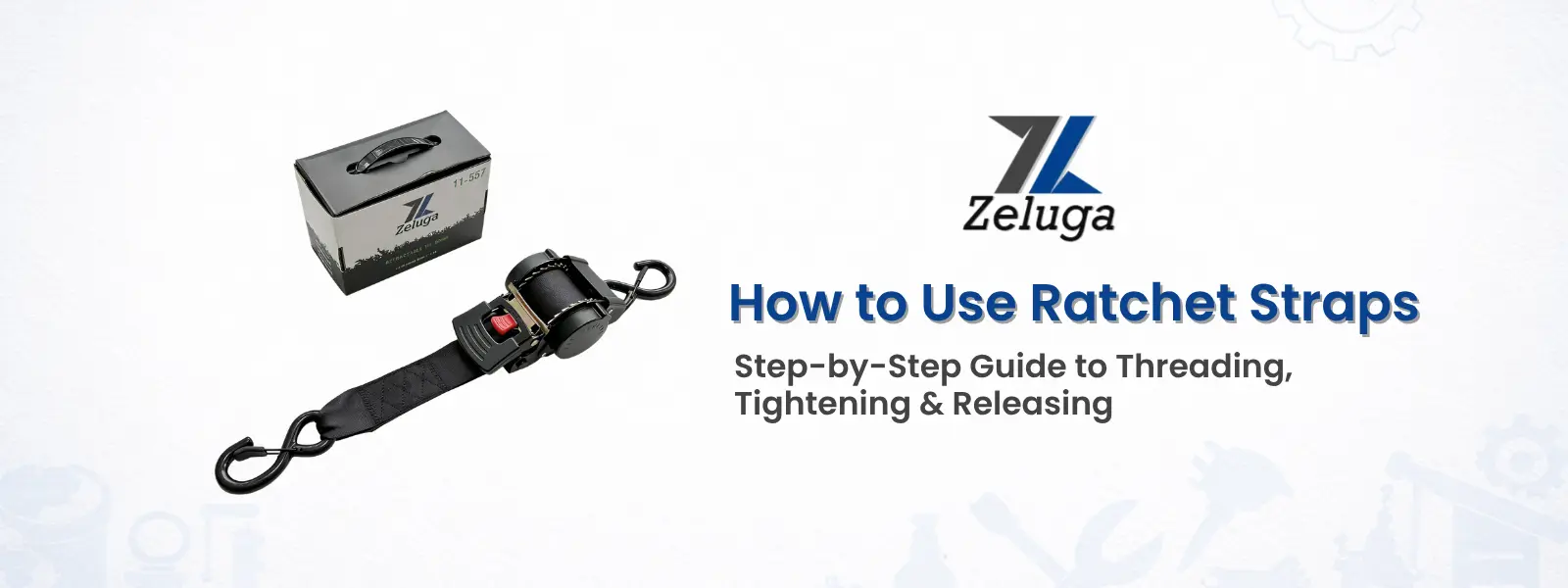
Ratchets keep loads secure by providing tension from the load to a proper anchoring point. Proper usage of ratchet straps is not only about tightening the ratchet handle. Threading, positioning, tensioning, inspection, and unloading are all important factors. The strap has to be properly loaded with enough tension but without any excess.
This guide provides detailed instructions on how to use ratchet straps and describes the mechanism of operation.
How Does a Ratchet Strap Work?
It consists of webbing, a spool, a ratchet handle and end fittings. The mechanism tightens slack and keeps the tension after locking the handle.
Parts of a Ratchet Strap
There are several major parts, including webbing, ratchet handle, release lever, spool and hooks. These parts serve different functions when applying and holding the tension during the securing process.
How Does the Ratchet Mechanism Create Tension?
Movement of the handle causes rotation of the spool, resulting in winding of the webbing on the spool. This reduces the slack and creates tension. When the handle is closed, it locks in place.
Functions of the Webbing and Hooks
The webbing is passed over or through the cargo and holds the created tension. The hooks serve for attaching the strap to suitable anchor points capable of handling the securement forces.
How to Use a Ratchet Strap Step by Step
The right usage of a ratchet strap begins even before making any tightening action. The steps must be followed sequentially since the wrong placement or threading might impact the proper securement.
1. Inspect the Strap Before Use
The webbing should be inspected for cuts, severe abrasions, burns, and damages to the stitching. All the hooks, ratchet, and the release mechanism should be checked before tightening the strap.
2. Position the Strap Around the Load
Position the strap so that it keeps the cargo in its rightful place. The webbing should remain flat and away from any sharp or abrasive surfaces.
3. Attach the Hooks to Suitable Anchor Points
The two hooks should be secured at points that will withstand the loading process. Each one of them should be properly attached and remain secure throughout the transportation period.
-
Thread the Webbing Through the Ratchet
Unlock the ratchet and insert the free webbing through the spool slot in the ratchet to allow removal of slack.
-
Pull Out the Excess Slack
Pull the loose end by hand before engaging the lever. Releasing extra slack helps in minimizing unnecessary clicks and giving you more control over the tightness of the strap.
-
Tighten the Ratchet
Move the ratchet handle back and forth to wind the remaining webbing around the spool. Continue until the strap feels secure without applying excessive force to the cargo.
-
Lock the Ratchet
After obtaining the necessary tightness, close the handle of the ratchet tightly. This ensures that the strap does not unwind during transport.
-
Check the Load Before Moving
Ensure that the hooks, the webbing, the position of the ratchet, and movement of the load do not exist prior to movement.
How to Thread a Ratchet Strap Properly
Threading is one of the essential steps when it comes to the proper use of a ratchet strap. It can be rather challenging to tighten the strap correctly when webbing passes through the spool incorrectly.
Open the Ratchet
Pull the lever to open the ratchet and expose the spool. Full opening will help you see the threading way clearly and avoid incorrect webbing placement.
Find the Mandrel or Spool
Identify the spinning spool in the ratchet mechanism. This is the place where the loose webbing end passes through and wraps during operation of the handle.
Feed the Webbing Through the Slot
Guide the loose end through the opening on the spool. Pass it through the right way depending on your ratchet type; make sure that the webbing remains straight.
Pull the Webbing Back Through
Once you pass the webbing through the spool, pull the loose end back. It will create the right winding pattern on the spool.
How Tight Should a Ratchet Strap Be?
The ratchet strap should be tight enough to keep the cargo in place, but not any tighter than what is required for the particular situation.
What Is Proper Tension?
Proper tension will make the strap feel firm and will also prevent unnecessary movement of the cargo in the securement system. Do not judge the tension simply through touch where a rated tension must be applied.
Why You Should Not Over-Tighten
Over-tightening the ratchet strap will cause damage to the cargo, may stress the webbing itself or the anchor points or just unnecessarily add pressure on the ratchet mechanism.
How to Check Whether the Load Is Secure
After locking the ratchet, it is important to review the whole system for security instead of checking only the tension.
How to Release a Ratchet Strap
In order to release a ratchet strap safely, one must handle it with care since there may be tension within the strap. First, release the mechanism and tension and then remove the strap.
Release the Locking Mechanism
First, pull the release lever and open the ratchet handle. This will release the locking mechanism, so the spool can turn freely without applying force to the ratchet handle.
Open the Ratchet Completely
The ratchet should be opened until the handle and mechanism are completely released. While doing this, one must not pull the webbing strongly when the mechanism is partly opened or locked.
Pull the Webbing Free
As soon as the ratchet is released, pull the free webbing through the spool. Remove the other part of the webbing slowly rather than dragging it on the ratchet or cargo.
Remove the Hooks Safely
First, remove the tension from the strap and then safely remove the hooks from the attachment point. When removing the hooks, one must have control over the strap.
Important Safety Guidelines to Using Ratchet Straps Correctly
Using ratchet straps safely involves much more than just knowing how to use the ratchet mechanism. It also requires the strap, hardware, anchorage, load, and total load securing system to be appropriate for the job.
Check the Webbing for Damage
Make sure there are no cuts, tears, major abrasions, burns, broken stitching, or any other type of defect. A ratchet strap that is extensively damaged should never be used to secure cargo.
Inspect Hooks and Ratchet Hardware
Always examine the hooks, ratchet housing, spool, release button, and other parts before using the strap. Any bent, broken, excessively corroded, or non-functional hardware must be taken out of service.
Protect Webbing From Sharp Edges
Sharp corners of cargo can damage or severely abrade the polyester webbing under pressure. Edge protection should be employed in cases when the strap comes into contact with a damaging surface.
Keep Loose Webbing Tied Down
Excess webbing should be secured to prevent it from flapping while driving. Loose webbing may come into contact with moving parts, the road, tires, or other abrasive surfaces.
When Should You Use a Heavy-Duty Ratchet Strap?
Pickup Trucks
A heavy-duty ratchet strap can be used for securing equipment, building materials, recreational vehicles, or other heavy loads in pickup truck beds as long as it is properly rated for the job.
Cargo Trailers
Cargo trailers typically haul heavier or bulkier loads that need reliable securement. Choose straps based on load weight, anchor strength, load configurations, and securement needs.
Motorcycles and ATVs
A ratchet strap can be used for tying down motorcycles and ATVs when proper anchor points and tie-down techniques are applied. Be cautious about any painted surfaces and fragile parts.
Construction Materials
Construction materials have varying weights, shapes, and surface conditions. Heavy-duty straps can be considered when they have compatible WLL and configuration for the task.
Furniture and Moving Loads
Furniture and other household equipment can need firm restraints when being transported. Choose an appropriate strap and provide protective coverings where necessary.
How Is the Longevity of a Ratchet Strap Determined?
Longevity is influenced by the overall structure of the strap itself, as well as how it is being used. Factors such as webbing, sewing, ratchet parts, hooks, storage, and weather resistance can affect how long it lasts.
Polyester Webbing
Polyester webbing gives a robust and non-elastic webbing option that is suitable for tie-down purposes. Even then, it will be affected by construction, usage, exposure, abrasion, and proper use.
Webbing Width and Construction
Wider webbing will increase the contact surface and will usually be used in heavy-duty tie-downs. It should, however, be taken into account with WLL, construction, and application.
Ratchet Hardware
The ratchet parts need to run smoothly and to engage properly when loaded with the intended load. Inspection will help spot any problems like corrosion, damage, bending or malfunctions beforehand.
Hook Design
Hooks have to engage with the proper anchor points and stay connected when transporting. The appropriate hook will depend on the anchor point arrangement and tie-down purpose.
Resistance to Abrasion and Weather
Continuous contact, sun, moisture, and exposure to the elements can affect strap materials. Proper handling and protection can help decrease the unnecessary wear and tear.
Common Ratchet Strap Problems and How to Fix Them
Problems with operation are usually caused by threading issues, improper positioning, excess webbing, damaged parts, and an inappropriate securement system. The cause should be identified first.
Ratchet Strap Won’t Tighten
Make sure that the webbing is properly threaded through the spool and that there is no excess webbing wrapped around the spool.
Ratchet Strap Won’t Release
Make sure that the release lever is fully activated before the ratchet is opened. Do not force the mechanism; if it cannot be opened, make sure that there are no damages to the mechanism.
Strap Keeps Twisting
Open the strap and move the webbing so that it lays flat across the cargo. Twisted webbing can result in uneven pressure on the strap.
Ratchet Gets Stuck
Stop applying any force to the ratchet if it does not function correctly. Make sure that the ratchet is in the release position, webbing is routed properly, and that there are no damages to the hardware.
Strap Keeps Coming Loose
Inspect the threading, the hooks attached, the anchors, and the tension. If none of the solutions work, then it might be an issue with the securement system itself.
Why Choose Zeluga Ratchet Straps?
Heavy-Duty 2-Inch Webbing
Zeluga ratchet straps have high tenacity polyester webbing made to withstand heavy-duty cargo securing purposes, where substantial strap strength is needed.

4,400 lb Break Strength
A 4,400 lb breaking strength specification clearly indicates a measurement of the strap’s strength along with its working load limit and usage.
1,467 lb Working Load Limit
A 1,467 lb working load limit specification offers buyers a measurement to consider when selecting the strap for their cargo securing needs.
Safety S-Hooks
S-hooks provide a convenient attachment point for suitable anchor points. Be sure that the hook and anchor point combination fits your cargo securement needs.
Made for Commercial Usage
Ratchet straps from Zeluga are made for professional buyers, businesses, distributors, and commercial purposes.
Conclusion
Properly using a ratchet strap simply involves proper set-up and inspection. Webbing needs to be threaded correctly, strap needs to be positioned correctly, appropriate anchor points need to be chosen, and only the correct amount of tension needs to be applied. Always work according to the working load limit and not just break strength. Inspect your set-up after you have locked the ratchet.
FAQs
How do you know if a ratchet strap is tight enough?
The strap should safely secure the load without any unnecessary tension. Inspect the entire securement system, including cargo movement, hooks, webbing location, anchor points, and the strap’s capacity rating.
Can you over-tighten a ratchet strap?
Yes, too much tension can cause harm to the cargo and can put unnecessary pressure on the strap, hardware, and anchor points. Just tighten it to what your application needs.
What is the difference between a ratchet strap and a tie-down strap?
Ratchet strap usually means a tie-down that uses a ratcheting mechanism to create tension in the tie-down. Tie-down is a more generic term for different kinds of cargo restraining equipment.
Can a ratchet strap be used on sharp-edged cargo?
A ratchet strap can be applied to such cargo if the application is appropriate; however, it is better to use appropriate edge protection since sharp edges can damage the webbing.
How often should ratchet straps be inspected?
They must be checked before each use and every time their condition may change. Check for cuts, abrasion, damaged stitches, hardware issues, contamination, and other visible defects.