

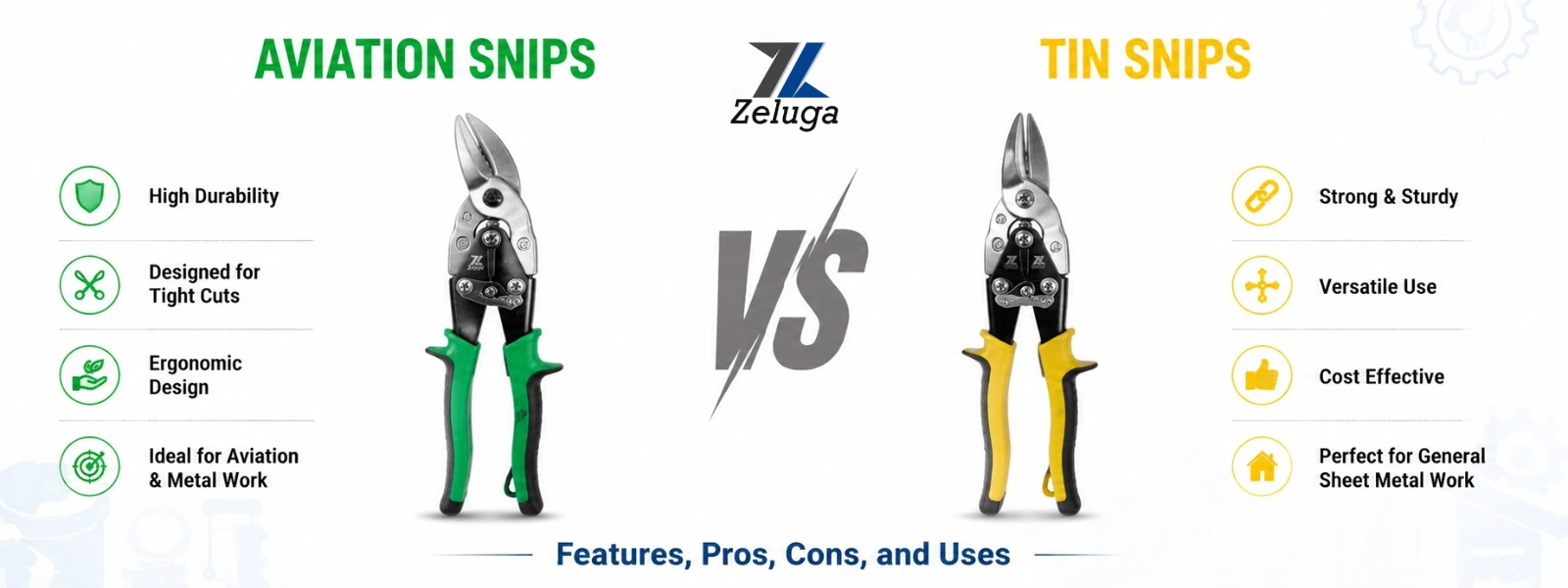
Working with metal sheets often involves the use of certain tools to make cuts. Using the wrong type of cutter may reduce your efficiency or result in poor cuts that will need additional time to repair. This is the reason why professionals usually consider aviation snips and tin snips when purchasing the appropriate tool. Although both cutters work with metals, they have specific uses and features that need consideration.
What Are Tin Snips?
Tin snips are hand metal tools that can be used for cutting thin sheet metal. They have a traditional lever mechanism, meaning that the entire cutting process depends solely on your hand strength. This cutting tool has a long history in the field of metalworking and continues to be used nowadays for certain applications. It performs well when cutting aluminum or other thin sheet metal.
What Are Aviation Snips?
Aviation snips are a more advanced form of tin snips, in which a compound leverage system is implemented to multiply the amount of cutting force generated while lowering the amount of hand power needed to do so. This makes them easier to use and offers greater control throughout the entire process of cutting. Aviation snips are commonly used by construction workers.
Common Applications of Tin Snips
Light Metal Sheet
Tin snips are ideal for cutting light metal sheet used for light fabrications, repair works, and light installation. The cutting tool provides sufficient control for materials that don’t need much power to cut.
Aluminum
Light metal sheets such as soft aluminum can be easily cut using tin snips. They are usually used for light fabrications, flashing adjustments, and light workshop works where neat cutting is necessary.
Flashing
Sheet metal flashing can be easily cut using tin snips. They are ideal when few straight and curved cuts are required.
Craft Work
Most craftsmen prefer tin snips for cutting light metal sheets used in crafts such as decorative items, signs, and model making.
Do It Yourself Repairs
Tin snips are suitable for light DIY repairs of thin metal sheets. They are ideal for homeowners who require a cutter for maintenance purposes only.
Uses of Aviation Snips
Roofing
Roofing professionals use aviation snips to cut metal flashing, drip edges, valleys, ridges, and panels. Aviation snips provide better control for precise cuts while minimizing hand strain.
HVAC Ductwork
Aviation snips allow HVAC contractors to make cuts to galvanized steel sheets for installing ducts and vents. Precision cutting provides an easier and quicker installation with clean edges.
Metal Fabrication
Fabricators working in sheet metal fabrication shops employ aviation snips to cut and trim metal pieces to be assembled. Aviation snips are preferred to tin snips for repetitive cuts.
Construction
Aviation snips are used for metal framing, siding installation, flashings, and general metal sheet cutting. Aviation snips can make straight and controlled curved cuts.
Automotive Repair
Aviation snips are used by auto body repairmen when performing body panel repairs and trimming replacement metal pieces.
Industrial Maintenance
Aviation snips are used by maintenance personnel when fixing equipment guards and ventilation enclosures.
Pros and Cons of Tin Snips
Pros of Tin Snips
Simple Design
The structure of tin snips is quite simple; there are fewer moving parts. Tin snips are easy to operate, easy to maintain and are suitable for people who need only basic sheet metal cutting.
Lower Cost
These tools are more affordable compared to aviation snips. In case you only cut thin metal sheets occasionally, tin snips will work great for you.
Easy to Maintain
Regular maintenance is simple due to the fact that there is only a pivot point in this tool, and regular cleaning and lubrication will make your tin snips work perfectly for years.
Suitable for Occasional Use
If you only cut thin metal sheets occasionally, tin snips will provide sufficient performance without spending extra money on a professional tool.
Cons of Tin Snips
Higher Cutting Effort
There is no power source other than hand force used to operate tin snips. The cutting operation becomes very difficult when done continuously over long periods of time or on tougher metals.
Less Efficient on Thicker Materials
The thicker the metal being cut, the more difficult the operation. It takes more time and effort to maintain the quality of the cut.
More Strain on Your Hands
Each cutting operation will exert more strain on your hands and wrists as tin snips lack a lever system that multiplies the lever effect on each cutting action.
Limited Control on Curves
Creating curves and cuts becomes difficult when using regular tin snips as it demands more adjustment in the process.
Pros and Cons of Aviation Snips
Pros of Aviation Snips
Less Cutting Effort
Aviation snips feature a compound mechanism which multiplies the effort with each squeeze. Less hand effort is needed and cuts become smooth when using aviation snips to cut metal sheets.
Better Control
Better control is achieved during the whole process as force is being applied effectively. This makes following lines on straight and curved cuts easier.
Faster Productivity
Cutting metal is a task that takes place daily, hence speed is an issue. Aviation snips make you do more cuts in less time; thus, it becomes a good option to use in the workplace.
Quality of Edge Improved
Aviation snips have a blade design that allows for smoother cutting and provides high-quality edge which prevents any rough cuts and minimizes the finishing efforts needed after the cut.
Built for Daily Work
Professional aviation snips are meant for use on construction sites, fabrication shops, roofers and HVAC applications daily.
Cons of Aviation Snips
High Initial Cost
Typically, aviation snips cost more than traditional tin snips. Nonetheless, professional metal workers find that their higher performance levels and longevity are worth the extra initial cost.
Different Models Required
Not all cutting operations are performed effectively by one aviation snip alone since there are straight cutting, left and right cutting snips. Therefore, professional metal workers have various aviation snips.
Heavier Than Tin Snips
The presence of the compound action design makes aviation snips weightier than traditional tin snips. Therefore, some people might feel their weight as they carry various tools during the day.
Learning Curve
In case you have used traditional tin snips before, you will require some time to learn how to use aviation snips properly with regards to diverse cutting directions.
More Than Some Users Need
For occasional household jobs, aviation snips are much more powerful than what you need. You can always use traditional tin snips to cut through light metals.
Aviation Snips vs Tin Snips Comparison
| Feature | Aviation Snips | Tin Snips |
| Cutting Mechanism | Compound-action for increased cutting force | Single pivot manual cutting action |
| Blade Design | Designed for straight, left, right, and offset cutting | Traditional straight blade design |
| Cutting Capacity | Handles tougher sheet metal with less effort | Best for thinner sheet metal |
| Ease of Use | Easier during repeated cutting | Requires more physical effort |
| Hand Fatigue | Reduced during long jobs | Increases with continuous cutting |
| Straight Cuts | Smooth and controlled | Good on thinner materials |
| Curved Cuts | Better control on curves | More difficult on tight curves |
| Thick Metal Performance | Better suited for heavier sheet metal within capacity | Limited on thicker materials |
| Precision | Better accuracy on professional work | Suitable for basic cutting tasks |
| Durability | Designed for regular professional use | Suitable for occasional work |
| Typical Users | Roofers, HVAC technicians, fabricators, contractors | DIY users and light repair work |
| Productivity | Higher for daily cutting | Better for occasional projects |
Difference between Aviation Snips and Traditional Tin Snips
Compound-Action Design
Perhaps the most significant difference is the compound action. It magnifies your cutting force, providing more power per squeeze and decreasing the effort required to make the cut.
More Cutting Power
These snips produce more cutting force without applying too much hand force to them. You can thus work comfortably when making cuts through galvanized steel, aluminum, or any other sheet metal.
Less Hand Force Required
Rather than depending solely on the grip strength, aviation snips apply the principle of leverage to each cut to provide you with relief after long hours of cutting through several sheets.
Better Leverage
Increased leverage provides better control of the cut while enabling you to cut steadily without having to push the blades through the material.
Increased Versatility
As opposed to the tin snips, aviation snips come in different types depending on the direction of the cuts. You can have snips for straight cuts, left curves, right curves, or even offset cutting.
Types of Aviation Snips
Straight Cut Aviation Snips
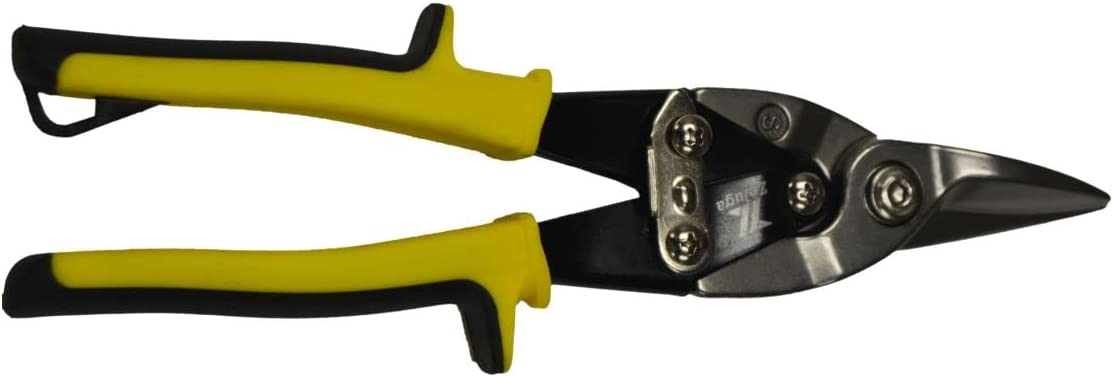
Straight cut aviation snips are ideal for long straight cuts and mild curves. These are most common in roofing panels, ductwork, flashing and general sheet metal working.
Left Cut Aviation Snips
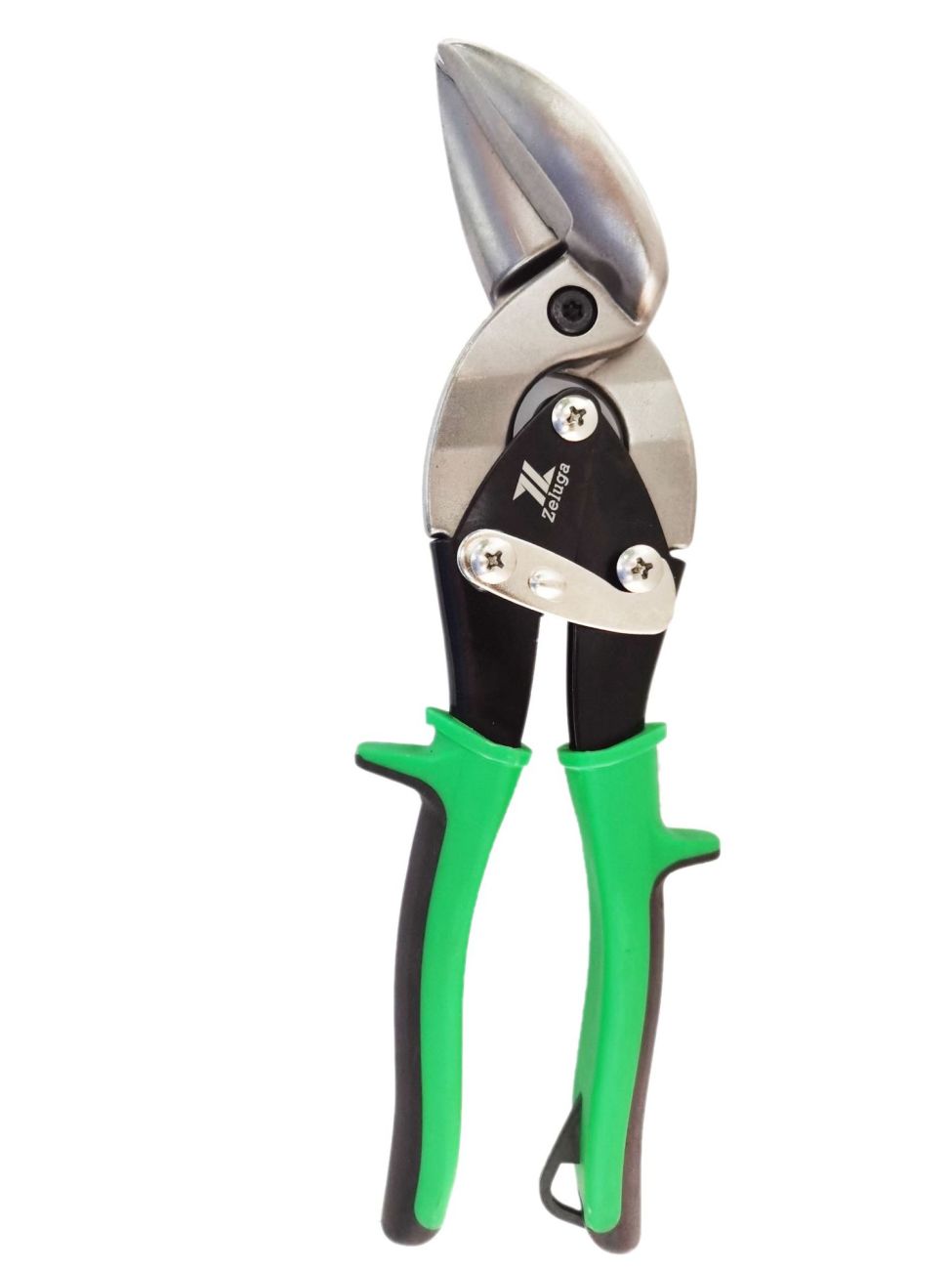
Left-cut aviation snips are used for left-hand curves and circular cuts. They are widely utilized in HVAC, fabrication shops, and the automotive repair industry.
Right Cut Aviation Snips
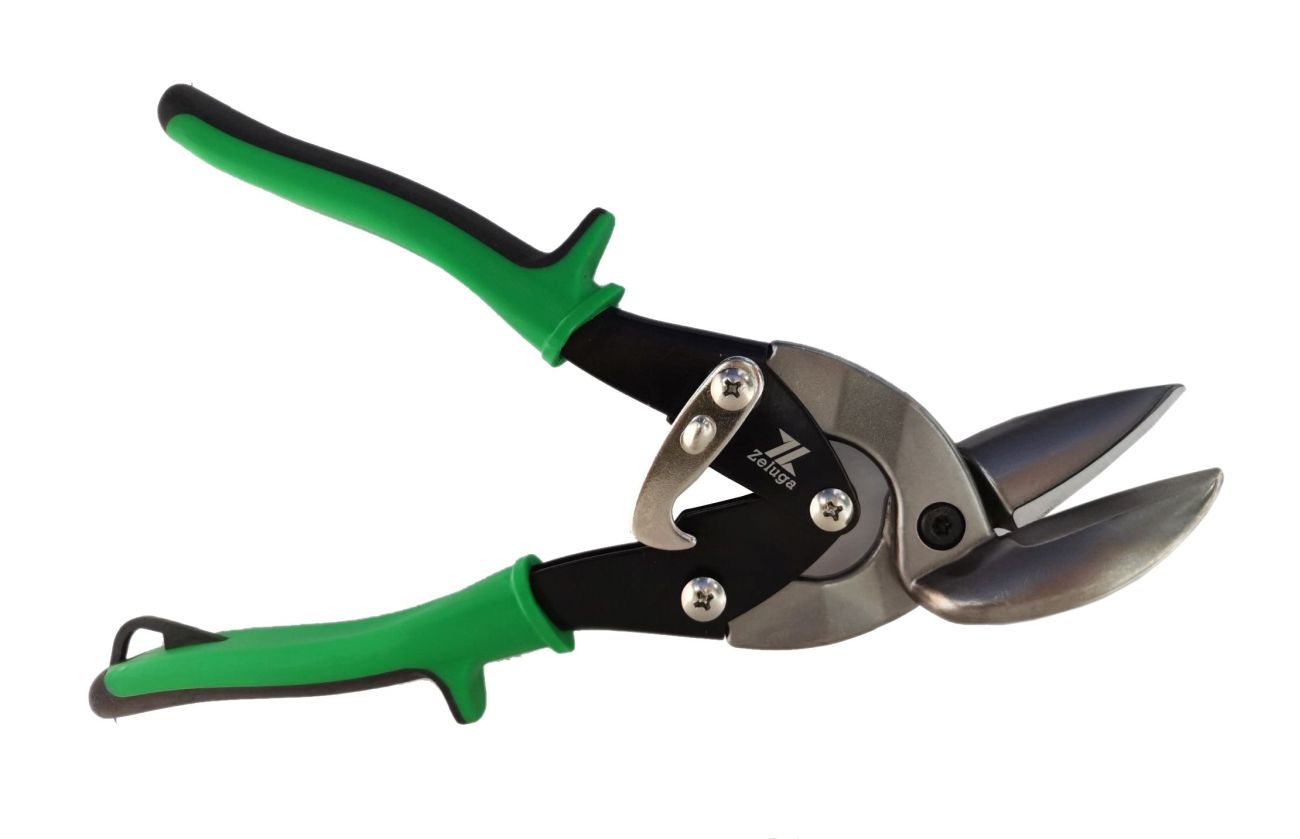
Right-cut aviation snips allow making right-hand curves more accurately. They are useful in roofing work, ductwork, curved sheets and metal fitting.
Looking to Source Aviation Snips in Bulk?
When purchasing aviation snips in large quantities, it is important to work with a reputable supplier and manufacturer in order to get products of consistently good quality. At Zeluga, we manufacture and supply professional-quality aviation snips that can be used in various industries such as roofing, HVAC, sheet metal fabrication, construction, and industrial maintenance. We have straight cut, left cut, right cut, offset, and aviation snip sets.
Contact us to discuss your aviation snips requirements.
Conclusion
Both the tin snips and the aviation snips have a significant role to play in sheet metal work. The tin snips still remain a viable option for cutting and repair work that do not need much effort. Aviation snips, on the other hand, provide the user with greater leverage, better control, and increased productivity when working with sheet metal on a regular basis. It all depends on what kind of material you cut, the frequency of use, and the nature of the cuts you need to make.
Frequently Asked Questions
Are aviation snips better than tin snips?
For light-duty work, repair work, and other jobs requiring only occasional cutting, tin snips will be suitable. Aviation snips are the preferred tools for professionals due to reduced hand strain and increased cutting efficiency.
Which snips are best for roofing?
For professional roofing jobs that involve cutting flashing, drip edge, roof panels, trim parts, etc., professionals prefer aviation snips as they ensure clean cuts and minimize hand strain.
Which snips are best for HVAC work?
Most professionals use aviation snips when installing HVAC systems as this tool helps in cutting the galvanized ductwork, vents, fittings, and sheet metal quickly and efficiently.
Do professionals still use tin snips?
Professionals continue to use tin snips for light cutting and trimming operations. Nevertheless, aviation snips remain the first choice for most cutting operations.
Which aviation snip should beginners buy?
Beginners should choose straight-cut aviation snips as they help in most cases. The addition of left and right cut models would prove beneficial as your scope of work increases